Posted on Last updated on by joeharman8|2 min read|52 views
The mat is cold. Breath rises, falls, subtle, uneven. Attention drifts, tracing the smallest shift in the space. A stimulus appears—barely visible—but it pulses through the body, through every fibre. Reaction arises as a fragment. If held, it isolates. If processed, it distributes.
The system can fracture, isolate, hold in one spot. Or it can flow, harmonised through posture, breath, and alignment. Reaction is optional, or at least isolating it is.
The unorganised body tends towards binary answers: resist or yield, tense or relax, advance or withdraw. The integrated body receives pressure continuously and speaks through degrees, uncorrupted by division.
Pressure comes. Fear comes. Neither commands. They signal, they inform. The body listens, but to what exactly? Micro-adjustments ripple from core to extremities. Energy is neither hoarded nor wasted; it is distributed, contained, integrated. The hara deepens and expands, a centre of gravity, of intention. Every exhale spreads that which is contained, every inhale gathers potential.
Tension is no longer a problem, nor a burst of resistance. It is concentration. It is a teacher, flowing through the system, guiding awareness, shaping the body’s capacity to contain, to expand, to return to the source. Each moment of strain is a dialogue: how much to absorb, how much to release, how to move without friction, without panic.
Thought recedes. The nervous system takes the lead. Action arises from structure, from alignment, from perception. Fear can pass through, unamplified. Presence is cultivated, deep, stable, ready. The body learns, and in continuously learning, it teaches the mind. Coordination, endurance, resilience—these emerge naturally, silently, without fanfare.
Energy oscillates internally, sometimes spilling outward, sometimes retreating to the core. Each cycle is a pulse of integration: distributed, regulated, aware. The container becomes a vessel: full, responsive, capable of both sudden motion and sustained effort. Nothing is wasted, nothing forced.
The work is quiet, subtle, relentless. Observation is continuous, even in stillness. Every movement, every breath, every adjustment carries information. The system adapts to what it receives. The body speaks in signals the mind does not need to interpret intellectually.
Presence is the pure signal. It is not forced; it is lived, moment by moment: a continuous refinement of energy and self-regulation, gradually distilled throughout the system.
Posted on Last updated on by joeharman8|2 min read|140 views
The mat is cold. Breath rises, falls, subtle, uneven. Attention drifts, tracing the smallest shift in the space. A stimulus appears—barely visible—but it pulses through the body, through every fibre. Reaction arises as a fragment. If held, it isolates. If processed, it distributes.
The system can fracture, isolate, hold in one spot. Or it can flow, harmonised through posture, breath, and alignment. Reaction is optional, or at least isolating it is.
Pressure comes. Fear comes. Neither commands. They signal, they inform. The body listens, but to what exactly? Micro-adjustments ripple from core to extremities. Energy is neither hoarded nor wasted; it is distributed, contained, integrated. The Hara deepens and expands, a centre of gravity, of intention. Every exhale spreads that which is contained, every inhale gathers potential.
Tension is no longer a problem, nor a burst of resistance. It is concentration. It is a teacher, flowing through the system, guiding awareness, shaping the body’s capacity to contain, to expand, to return to the source. Each moment of strain is a dialogue: how much to absorb, how much to release, how to move without friction, without panic.
Thought recedes. The nervous system takes the lead. Action arises from structure, from alignment, from perception. Fear can pass through, unamplified. Presence is cultivated, deep, stable, ready. The body learns, and in learning, it teaches the mind. Coordination, endurance, resilience—these emerge naturally, silently, without fanfare.
Energy oscillates internally, sometimes spilling outward, sometimes retreating to the core. Each cycle is a pulse of integration: distributed, regulated, aware. The container becomes a vessel: full, responsive, capable of both sudden motion and sustained effort. Nothing is wasted, nothing forced.
The work is quiet, subtle, relentless. Observation is continuous, even in stillness. Every movement, every breath, every adjustment carries information. The system adapts to this content. The body speaks in signals the mind does not need to interpret intellectually. Presence is not forced; it is lived, moment by moment, a continuous refinement of energy, and self-regulation, gradually distilled throughout the system.
Posted on Last updated on by joeharman8|11 min read|161 views
Practice begins by consciously correcting individual movements, but it matures when those corrections become part of one integrated organisation. Rather than continually supervising posture, breathing, and movement, the body gradually learns to organise itself. This frees awareness to engage with the environment instead of constantly maintaining the body.
Energy released too early substitutes speed for timing and limits potential. The martial artist learns to dissolve pressure internally, integrating it rather than wasting it externally. It is often better to foster a sense of containment, so that pressure dissolves itself within, rather than wasted on externalities as they first initially appear. This dissolution simply means creating a mature and subtle energy out of more immediate opportunities for its expression. Then, your awareness seems to become more distributed across the environment while remaining quietly centred. In yoga, the point referred to as Bindu is traditionally located at the back of the head, near the crown but slightly posterior. It is described less as a chakra than as a subtle source or point of emergence and dissolution. This may be why warriors of the past, as well as elsewhere, traditionally wore a topknot, to focus one’s attention at that point at the back of the head.
In some schools of Kundalini Yoga, Bindu is associated with the place where differentiation emerges from unity and returns to it. Meditation on Bindu is sometimes said to dissolve the sense of individual effort while increasing clarity of awareness. There is also the concept of bindu visarga, literally “the point from which the drop flows.” Systems such as Taijiquan often speak of suspending the crown, as if by a golden thread, while maintaining awareness extending behind the body. There is also an important point called Yuzhen (“Jade Pillow”) at the back of the skull, anatomically close to where many people locate Bindu. This region is said to be a place where upward and downward forces balance. Many teachers say that when this region releases, peripheral awareness naturally expands. They rarely instruct students to stare at the point mentally. Rather, the point becomes quietly alive while awareness fills the entire environment.
From a contemporary neuroscience perspective, it’s also plausible that sustained attention to that region is not significant because of the tissue itself, but because it coincides with a mode of attentional organisation. The posterior part of the head is associated with visual and spatial processing, and changes in muscle tone around the upper neck and occiput can alter one’s sense of orientation and body schema. That does not prove the yogic interpretation, but suggests a relatively simple organising variable that coordinates many degrees of freedom simultaneously. Rather than consciously adjusting ten different aspects of posture, one stable attractor reorganises the entire system. Whether one interprets that attractor as Bindu, Yuzhen, awareness itself, or simply an attentional strategy depends on the tradition.
One tradition says “nectar descends.” Another says “the Jade Pillow opens.” Another says “the crown is suspended.” They are useful because beginners don’t yet possess a global organising principle. So an instructor says: tuck the chin, lengthen the neck, relax the shoulders, engage the lower abdomen, soften the ribs, or unlock the knees. Each cue improves one variable. But eventually, there comes a point where thinking through a checklist becomes too computationally expensive. Instead, skilled performers appear to discover what systems theory would call a higher-order constraint. Rather than controlling twenty individual movements, they find one organising principle from which those movements emerge. In other words, the fragments dissolve into the making of making the whole.
If dissolution is understood only as negation—getting rid of the ego, emptying the mind, eliminating tension—it can sound like a process of continual removal. But if dissolution is understood as the natural consequence of emergence, then practice becomes fundamentally constructive. One does not spend one’s time destroying old patterns; one cultivates the conditions under which more coherent patterns arise, and the old ones lose their necessity. This is why, perhaps, “dissolution through emergence” is clearer than simply “dissolution.” It avoids implying that development is about subtraction.
That is a subtle but important distinction. Some forms of concentration narrow attention around an object. What we’re looking at here, sounds more like a local point acting as an organiser for a global field of awareness. In that sense, the “point” is valuable not because attention stays there, but because it allows attention to move freely everywhere else without becoming fragmented. The sense of a rigid centre softens while awareness becomes more inclusive. That is a remarkably consistent theme across advanced descriptions in yoga, internal martial arts, Zen, and other contemplative traditions, even though each tradition expresses it through its own symbols and metaphors.
To dissolve doesn’t mean disappearance, it means integration. Another way of looking at this is that your energy finds freedom, which is all that really matters. This is why it is important to perform action through the core and out through the periphery. The body’s physical centre creates a kind of internal heat, which builds pressure. There is often a waste product built up in martial arts practice, particularly the physical systems (e.g. metabolic by-products, accumulated fatigue, excess muscular tension, etc.). Waste product is best released and flushed out by working from the centre and out. Otherwise, exercise becomes more inefficient and draining. So all of this waste product dissolves when one becomes integrated because at that point movement and energy no longer exists in isolated form. Dissolution is therefore not merely destruction but reabsorption into a more unified condition. Emergence and dissolution are opposite movements of the same process.
Consider someone sitting quietly in meditation. If their attention is continually occupied with correcting posture, regulating the breath, or eliminating distracting thoughts. Attention remains engaged in maintaining the organism rather than broadening its capabilities. By contrast, if awareness gently rests upon what some traditions call the Bindu—the point of dissolution—these individual corrections gradually become integrated into a single organising principle. The body settles without continual supervision, the breath deepens naturally, and awareness becomes free to participate in the wider field of experience. If you brining anything into your conscious awareness, then it naturally becomes all encompassing rather than restrictive. In this way, even becoming consciously angry, and bringing this into to your awareness, rather than focused attention, can lead to liberation from anger.
Intuition does not appear because something mystical has been added, but because the mind is no longer consumed by maintaining itself. This is an important distinction. Awareness is often mistaken for directing attention towards tension itself. Yet continually attending to what is fragmented can unintentionally reinforce fragmentation. Instead, awareness may be directed towards that which is all-encompassing, allowing the fragmented parts to reorganise themselves within a more coherent whole. Then, there is no more focus on singular aspects. When people say, “Bring it into your awareness,” they often behave as though it means, “Make this the only thing you think about.” A broader awareness approach is: “Recognise that the shoulders are tense, but continue to perceive posture, breath, balance, the environment, and the task as one integrated whole.” Just as posture settles when the organism becomes better organised, emotional states also begin to settle without becoming the primary object of attention. This is why working with the breath, the posture, and alignment is so important.
Training and rest form a complementary polarity: effort builds containment, and recovery allows maturation. When this happens in a balanced way, there is fluidity and circulation. Then, there is a presence. Even small encounters, a playful dog, a tense situation, become opportunities to practice disciplined presence. Together, breath and body acts as a container system. One who can integrate their system effectively is never afraid of pressure. The accomplished martial artist simply uses energy as needed in the best possible way, and transforms it into a greater possibility. This is why they often remain impartial to outside events. It is not because they ignore outside factors. Instead, the “self” dissolves because experience is no longer organised around defending a fixed identity. In internal martial arts, the same principle appears in physical movement. A beginner tries to activate each limb separately, with no regard for whether or not they are effective in the wider environment. An experienced practitioner generates movement from a single integrated organisation. The isolated actions have dissolved, but only because a more coherent movement has emerged in the wider sphere of experience.
The countless separate adjustments—head position, shoulders, breathing, gaze, muscle tone—do not need to be consciously managed because they become expressions of one organising process. Accomplished martial artists often see that they themselves are responsible for creating greater organisation in the world. Then, they neither explode nor shut down, they become fully integrated, like a tiger in the jungle. The tiger draws strength from the scarce resources of the jungle, and opportunity is created from this scarcity. It is not that they just live minimally. The jungle is a place where awareness gathers without becoming narrow, and because a more integrated organisation emerges from it, the older, fragmented way of organising perception quietly dissolves. That makes dissolution an active, creative process rather than a passive loss of autonomy or strength.
The core maintains stability, guiding limbs, breath, and attention. Containment happens at the centre, the foundation level. When you strike, you keep organised from the core because the core is the Hara centre, the body’s centre of maintenance. The centre of maintenance is not necessarily the centre of awareness. On the other hand, maintenance does not happen at the release point, where energy is distributed. In other words, maintenance is centralised; awareness is distributed. Release happens at the periphery. The Bindu does not necessarily feel like the place where your body is maintained. The lower abdomen still feels like the place where weight settles, breathing organises, and force is transmitted. Maintenance preserves continuity. Orientation allows adaptation. Too much maintenance without orientation becomes rigidity. Instead, the two continually inform each other. The idea is to start by focusing on the Hara, and then to broaden one’s awareness. This is like the master watching the student and correcting them, before later allowing more autonomy. The supervision dissolves, not because of neglect, but because the student’s self organisation eventually reaches a point where conscious control is no longer needed.
When the core is stable and maintained in an integrated way, the limbs move and release freely. Breath and attention remain available to you without getting caught up and tied to the external considerations. Otherwise, breath and attention become linked with fluctuating situations and transient events, and the brain takes all of this in. The core dictates what pressures are felt there, rather than your brain getting worked up and projecting this into your system. When the brain gets caught up in cycles of activity followed by passivity, this creates a different kind of pressure, which is not sustainable. If this particular pressure is localised in the brain pathways, rather than the physical centre of mass, then psychological troubles are a natural consequence. When breath and body release an action from the core, it is balanced and contained, rather than erratic and out of proportion. Organisation should reduce conscious workload, as well as physical strain, rather than increase it.
Premature discharge breeds anxiety, reactivity, and wasted effort. There is a sense that the clock is ticking and time is running out. Just as if you become settled and still you can find peace in any kind of situation, the same is true if you become unsettled and erratic, you can find stress in the smallest of matters. This is the emergency mindset taking over, which does not need any big problems to interpret things as a disaster. As integration develops, it is not energy that dissolves but the emergency organisation built around it. Pressure no longer demands immediate release because it has become part of a wider, more coherent system.
Controlled integration develops resilience, adaptability, and enduring capacity. This is so whether there is any external need for these things. This is because such enhanced capability is not defined by external situations. This kind of enhanced capability creates a widening sense of time, but also a greater capacity to act. In this, there is swiftness of action, but no hurry. As organisation matures, conscious effort becomes less concerned with maintaining the organism and more available for participating in the environment. The body increasingly sustains itself through its own integrated organisation, allowing awareness to become broader rather than more narrowly focused. This is not a withdrawal from action but a deeper participation in it. In this way, what appears to dissolve is not capability but unnecessary supervision. Local adjustments become integrated into a coherent whole, allowing posture, breath, and movement to emerge naturally rather than through continual correction. Dissolution therefore occurs through emergence: as a higher order of organisation develops, the fragmented processes that once required conscious attention gradually lose their necessity.
Posted on Last updated on by joeharman8|10 min read|192 views
Thoughts Are Weather, Not Orders
Cognitive capacity is largely determined by bodily state. Beyond certain parameters, your emotions push, but your body’s resources can’t sustain the pressure. That is, unless you are a suitable vehicle for this energy. In terms of martial arts and self defence, developing ones body through martial arts is a method of stress distribution and energy regulation. In this way the martial artists does not suffer stress but is able to transform what would be stress one person into an enhanced possibility within themselves.
Motivation energises the system, but regulation prevents depletion.You can shift the balance from a sudden reaction to danger, which brings a kind of explosive overwhelm based on limited perception and a cognitive representation, to a more grounded and body based response. You can do this by working with breath, posture, movement. This can be done without changing thoughts at all. There may still be thoughts going on, but the contents of the brain in terms of images, sensations, and thoughts is minimal and does not disrupt your attention.
In traditional martial arts, they did not bother thinking in term of just becoming smart or technically trained. Technical details which are stored in the brain as short term memory are not the same as working with the long term neural networks. The short term memory is often an attempt to represent what is deeply understood, often poorly. On the other hand, working with an externally structured pattern and replicating that is a good way to start but after a certain point it is just recalled knowledge, rather than an expressed intelligence.
“You can look at them and use them if you want, but that’s different from imitating these surface expressions.”
In fact, many of the masters of the past urged us to ignore our thoughts and treat them as superficial, passing like the wind. You can look at them and use them if you want, but that’s different from imitating these surface expressions. There is a lot of wisdom in this, because according to martial arts thoughts are not to be enshrined or suppressed, they are just passing events, like the weather to simply observe rather than take orders from.
We think that in some way if we are strong, determined, motivated, that this will bring guaranteed health and confidence. However, it is necessary to develop your system in such a way that it thrives on what it creates in its own way, rather than relying on outside happenings and events. You then develop a strong sense of discipline and internal motivation, which when developed in the long term, brings its own kind of unique prowess to everything you do. Then, rather than because you have undergone some kind of short term competence training and recalled some impressions, you are able to generate something of substance.
So why wait for this teacher or that training method to come? Grow them from within, according to a stable platform and they will naturally develop. A fighter who engages with the their own thoughts or those of others simply hesitates and loses timing. Thus, martial arts historically trained practitioners to let thoughts arise and dissolve without engagement, keeping perception grounded in posture, breath, and the environment. Then, the benefits of training occur without changing thought content. On the other hand, you can be extremely motivated and full of technical skill but still dysregulated. Confidence from surface level competence is fragile. Confidence from a deeply held and formidable structure is stable. This is true competence.
True prowess comes from developing a system that can self-organize, self-regulate, and self-generate. In many ways, mental health is not dependant on the thoughts floating around in your head. Instead, how you engage the nervous system’s capacity to regulate attention, emotion, and action independently of transient mental representations and passing thoughts is the way foreward.
So, what I’m talking about is not just winning a fight, a match, or just getting fit. This is bricks and mortar stuff, where what you grow is inseparable from what you yield. Your thoughts and emotions might bring rain with them, which actually causes growth. rather than removing these, let them do as they will non judgementally. When I say non judgementally, this has been corrupted and can easily lead you to becoming judgemental about everything and fixate on certain things. What I mean is for you yo develop a no mind mind set.
Tomorrows skills are todays crops, which require uncertainty and contradictory conditions, like any dynamic environment in order to thrive. Thoughts, like rain, may feel disruptive. But rain feeds the soil. If the ground is stable, regulated, structured, and integrated, rain produces growth. Understand this, so that there is an interconnection between what you do and how you are, rather than letting thoughts govern action by default.
When you perform intrinsically meaningful activity, that means there is no external motivation. Yes there are external things happening, but there is no carrot and stick. If there is a thought, then there is a thought. Either way, you act as needed, not according to the thoughts going on in your head. This requires a certain clarity, and a lack of distortion of the mind. When there is no distortion, perception and attention occurs faster than thought because it happens unimpeded. It is not that you must have some thoughts and ideas to have attention. There can be attention and perception unattached to thought. In such a state, response becomes immediate, efficient, and fluid — not because thought is suppressed, but because it is not obstructing perception.
So what drives this process of perception without thought? It is simply that you remain fundamentally engaged with the activity, whether or not there is any reward or motivation. It is not that there is no thought happening. Action is not independent of thought, but it is not governed by it. Just as the crops grow without being destroyed by the rain and wind, you too grow as conditions wash over you and you continue in your growth. Growth requires diverse conditions, and thought is a necessary part of this. True development does not occur in sterile mental silence. When engagement is steady and distortion is low, the system reorganizes itself over time. Then, growth becomes continuous and perception led.
Thoughts and emotions gain a dominant influence when regulation is lost and identification occurs. Action then becomes repetitive and rigid. Thoughts then become compulsive and identity forming, rather than just informational or integrated. Mindfulness helps without changing thought content precisely because your activity is not identified with thought but with action and perception. So participation in thought becomes a vonantary process. Then, rather than your work being rewarded by relief from hardship or effort, the process is the product.
“When there is no inner bargaining, that reduces stress load and there is greater yield.”
When you voluntarily become the effort, rather than the result of some reward, this is the same as saying there is no identification with thoughts. There is no transaction, nothing in it for you. and yet, this kind of action improves mental health and wellbeing without disputing existing beliefs or relying on transient motivational states. That means there’s no pay off. When there is no inner bargaining, that reduces stress load and there is greater yield.
Why Survival Is a Terrible Default Mode
If training constantly triggers survival responses, the practitioner becomes good at panic, not endurance. So don’t drag yourself through the process just to get to the end result so that it is over. Staying grounded and centred, rather than dispersed, and in a no mind state, these are all instructions for staying out of survival mode unless absolutely necessary. Training should bias the nervous system toward modes of action that support sustained effort rather than emergency mobilisation. This means that every moment of engagement is life sustaining and stabilising, rather than survival based. You then continuously ride the wave of your own unfolding success, whether you win or lose. This all develops your ability to sustain effort without collapse, and your capacity to sustain this is a consequence of the time you have spent cultivating this process.
What you need to do is to find what uniquely inspires you. You do not need to spend hours practicing skills superficially to be a good martial artists. You will only become a technician that way. When you spend intimate time on all aspects of life, such as the meditative side, how you work, how you recuperate around training these martial arts skills, then you will become better as a result. So you can do minimal physical practice, in a disciplined and sustainable way, whilst spending time away from training. Then, all of your activity enhances the way you are. This is not the same as being lazy with training. When you become much more susceptible to growth and development, rather than just training to constantly triggers survival responses, your growth is ensured. Then, you are involved with everything rather than just a few hours of intense training at the physical level.
Fear Is Not the Enemy
Effective training prioritises sustained, regulated effort over short-term survival reactions, allowing action to arise from structure and perception, instead of cognitive overload and thought. So the idea is to get as involved in everything more broadly, just as you would with certain formal martial arts and self defence training. Then, you become fearless, because there is nothing you are not competent and involved with. This is the same as saying you are all inclusive. When you become excessively fearful, it is natural to want to dominate others and exclude them. So in dominating others, this is just a different way of identifying with fear.
When fear exceeds a person’s capacity to regulate it, the nervous system doesnotsimply remain afraid. It seeks resolution. Domination is often a compensatory strategy for uncontained fear. This is why fear-based societies drift toward domination even when intentions are good. This is yet another example of how thoughts about activity are not the same direct perception and action. When fear cannot be carried, due to weakness and corruption, it is imposed on others. The way to handle fear is to neither deny it nor act upon it, but to work on self regulation and strategies to impede its amplification to an out of proportion state.This brings mental clarity. Clarity means the mind is not distorted by excessive narrative, emotional amplification, or self-referential fixation. Then, fear can exist without needing to control others or becoming reduced by it.
Excessive thoughts often fuel fear. So thoughts are not the source, they are fuel. When you don’t engage thoughts, you allow the fear response, which is primarily physiological, to run its natural course.Fear does not require thought to operate, and can easily become amplified and out of proportion if you allow if to command you. Fear is not the enemy, nor is it the master. By relying more heavily on becoming grounded and robust, you remove cognitive amplification of thoughts. Let fear pass through you, and you are liberated from it altogether.
Epilogue
What we call resilience may have less to do with toughness and more to do with efficiency. Systems that force people into narrow modes of functioning increase stress by design. Practices that widen the circuitry—through movement, posture, breath, and individualised development—allow the same pressures to be sustained with far less cost. This means you shift to heightened attention, without the noise and distortion. This is true of martial arts, and elsewhere. The question may not be how much stress a person can endure, but where that stress is allowed to go, as well as how you relate to a given situation. When you are able to self regulate and engage continuously, response becomes immediate, efficient, and fluid. Not because thought is suppressed, but because it is not obstructing perception. Then you do not comment on the rain, you just continue growing.
Posted on Last updated on by joeharman8|7 min read|184 views
The mind should be clear thinking and you should remain aware. In this way the quality of your behaviour rises to such a level that you are able to act properly without turning the power up to the max suddenly. When adrenaline then hits, it is just a bonus.
Any martial artist will tell you that power comes from a relaxed state. This is because there is a steady current which is working as it is, rather than needing any kind of external stimulation to get it going properly. So the mind should be clear thinking and you should remain aware. In this way the quality of your behaviour rises to such a level that you are able to act properly without turning the power up to the max suddenly. When adrenaline then hits, it is just a bonus. Put differently, your behaviour is at maximum capacity without being artificially high in any one dimension. It is for this reason that when it hits the fan, the martial artist is already doing something intelligent when they get an additional boost of adrenaline.
Let’s say you have a pair of speakers. If the speakers are high quality, you can clearly hear them at volume level 30. Another pair of speakers needs to be turned all the way up to 100 just to hear what’s going on.
Most of us grew up with the idea that stress helps us perform. But this only allows you to act in specific ways at an high level. For example, however you are get’s amplified in some way. Let’s say you have a pair of speakers. If the speakers are high quality, you can clearly hear them at volume level 30. Another pair of speakers needs to be turned all the way up to 100 just to hear what’s going on. They are low quality, and one dimensional in terms of sound At the same time, there is a lot of unpleasant noise and interference going on with the bad but loud speakers. On the other hand, all of the supply lines and working properly in the quieter set of speakers, not just one or two circuits. Because of that, you get a balanced, regulated, and natural sounding output. It is the same thing in martial arts.
When there is a love for whatever you are doing, and the reflexes and basic fundamental skills are there, I think you can perform a lot better and with less emotional volatility. This love for what you are doing replaces the need to become dominant over others and increase the voltage in a volatile way. For example, when you love what you’re doing, dopamine release becomes tied to mastery and meaning, rather than external reward or reaction to external stimulus. This will at least bring down the need for craving stimulation from the sudden onset of environmental cues, in order to get the system up and running properly.
In terms of martial arts, rather than hyping yourself up and glaring at people insistently, you can disarm somebody completely by the way you are. You can walk through the situation rather than feeding it. Then, the simple act of remaining physiologically relaxed and disciplined is enough to diffuse hostilities instead of butting heads and puffing your feathers. This is known as fighting without fighting. Even if for some reason there is still a great need for external stimulation, or you are addicted to certain behaviours, building a solid foundation for internal reward systems can greatly reduce this need over time.
You should act before such thoughts arise by having everything within your gaze and fixating on no detail in particular. This is how the way you look at people can influence your physiology and theirs.
You should not think “That guy is staring at me, I must act”. You should act before such thoughts arise by having everything within your gaze and fixating on no detail in particular. This is how the way you look at people can influence your physiology and theirs. When yo are broadly aware but not reactive, you can then shift the gaze seamlessly so that you don’t cause other people to see you as some kind of hostile competition. When you remain aware before some kind of emergency situation arises, you do not need to suddenly boot up. You only need to do this if your system is switched off or has collapsed for some reason. If you are steadily active, you not only are better at defending yourself, you are better able to absorb the energy of the situation so that you and it are one and the same.
Flowing Into Strength: Stability Through Continuous Awareness
A dead and inert tree would simply be blown over by a gust of wind. A strongly rooted and vibrant tree would absorb some of the energy from the wind, sway with it, and its roots would even benefit from the pressure exerted upon it by getting stronger.
When you overall system is balanced in in tune with the environment, there is a completely different response to emergency situations. First of all you are not shifting from zero to one hundred. You are also better able to withstand pressure. Let’s use the example of a tree. A dead and inert tree would simply be blown over by a gust of wind. A strongly rooted and vibrant tree would absorb some of the energy from the wind, sway with it, and its roots would even benefit from the pressure exerted upon it by getting stronger. In the same way, the martial artist sinks deeply into the posture and absorbs the energy of the situation, remaining flexible in body and mind.
The thing to remember is that when these self defence systems were devised, life expectancy was low in most cases. For example, in China life expectancy was around 32 years old as early as one hundred years ago. Obviously, the Chinese systems were developed well before this, when life expectancy was even lower. In other words, the kinds of survival responses needed when life was much harsher was a lot different to what is needed today. So martial arts in the modern day must be viewed in this context.
Conditions today are not as tough as they were in the past. Although we have learnt to complain about everything, there is not such a need for constant survival mode all the time. At the same time, if you don’t look at how things were done, you don’t have the drive to do better. For example, there would be no need to live well if you didn’t take care of the need to survive. In fact, living well is built upon a good foundation of survival which is proportionate to need. The tree grows out of a mixture of turbulent environmental factors as well as a steady supply of life sustaining energies. In the same way, the martial artist is able to empower themselves through turbulence as well as energy cultivation, which are always linked.
If a tree was in survival mode all of the time, there would be no flowers fruit. The survival aspect is the foundation, the root. There’s a lot of digging around and feeding going on there, at the root level. So the survival instincts can be seen as a moving foundation, rather than a secure structure which is fixed. The secure structure, which is fixed, is built once there is a strong foundation for survival to happen, which is fluid. So in order to fix yourself strongly, you must remain fluid yet immoveable.
Posted on Last updated on by joeharman8|11 min read|115 views
“In terms of martial arts, this ecological growth means internal renewal and overall health improvements over time. So there is an incubation period which fleshes your system out as the energy settles in. It is not just a case of flooding yourself with hormones so that you can dissipate them in some kind of activity.”
In martial arts, people want to practice in such a way that they become physically capable and healthy, as well as mentally balanced. However, in practice this often does not happen in any meaningful way. When you look around, most of the martial arts styles out there are teaching tricks to get you out of a sticky situation. Or, they are teaching you to take part in some kind of elite sport which has no meaning outside of competitive circles. Whilst it can be beneficial to practice these tricks of the trade some of the time, most of it can be learned fairly easily, even on the internet.
In terms of output and fitness, the activity levels have gone up, but the internal development has not”
A few years ago, learning something like karate or Taekwondo meant you had to go to a dojo. Even then, most people quit without learning much at all. Today because all of freely available technical information which is so easy to find, you see lots of people able to punch, kick, throw, and all sorts of other things. The information is much easier to obtain and people are able to do these things even if they have never been to a formal class. Going to the class should create a conducive atmosphere in which you learn to develop as a person. However, all we see nowadays are classes packed with people going through the motions or getting hyped up and excited into activity in some way. So it has taken on the character of a nightclub in many ways.
The idea behind martial arts is to empower the internal side of the human being, not just to cover their external requirements. This is not happening at the moment on any large scale, even if there are more frequent training opportunities. So in terms of output and fitness, the activity levels have gone up, but the internal development has not. Without upgrading the internal side, the external activity will not develop in a self sustaining way or become meaningful to the individual. As people go through the motions, the body will just accumulate injuries and other stresses which will wear it down over time. This is what happens when martial arts turns into a competitive sport or business enterprise in the market place.
Just as the minerals from the sea rise and spread across the land, bringing nourishment to support plant growth, the hormones produced from the gut and elsewhere are distributed across the body to facilitate growth and repair.”
When you perform powerful activity, such as in martial arts, it is important that the energy is delivered from core of your being, extending itself more widely from there. Every action you perform has an impact on your own internal health and well being. During strenuous martial arts activity, the bloodstream delivers hormones to the organs and tissues, just like a river delivers water to the land. This ensures growth and renewal as the process of self development unfolds. Just as the minerals from the sea rise and spread across the land, bringing nourishment to support plant growth, the hormones produced from the gut and elsewhere are distributed across the body to facilitate growth and repair.
The gut is like the deep ocean vents, the activity of it creates currents and forces which lead to environmental change. This environmental change leads to ecological growth. In terms of martial arts, this ecological growth means internal renewal and overall health improvements over time. So there is an incubation period which fleshes your system out as the energy settles in. It is not just a case of flooding yourself with hormones so that you can dissipate them in some kind of activity. Doing so just puts you back to square one. Each individual will act according to their needs and compulsions. This might mean that some energy is allocated to physical activity, whereas a certain amount is also allocated to spiritual growth. For some people, martial arts means just moving around and expending energy. To others, there is more of a transformational element to it which ends with internal development.
Today, lots of people talk about medical interventions to correct poor health without any idea about how to kick start the internal health process. In many cases, these interventions can also be used to support internal growth, rather than constantly relying on external supplements. Internal martial arts means you manage your state of health from within, with or without outside help. According to the internal martial arts perspective, external supplements or external activity is just a way to trigger or kickstart the system predominantly. You can then do anything in a positive state.
Once you reach a state of good health and well being, you know by inference how to manage this and what to do as time goes on. It is like when you get to the age of thirteen or so you automatically begin to understand why people generally get married and start a family. This does not need to be taught by strangers. At the same time, there is guidance needed. When you study life closely, rather than just what is written about it, you naturally become aware of how to manage things.
Exercise, digestion and stress, all trigger hormonal development. In order to prevent dissipation of this internal energy, you need to a get a wide spread happening.
Martial arts schools these days are managed in such a way that you train in the evening and then flop in front of the television by the time you get home. So there is often no momentum gained from spring boarding yourself into activity during the martial arts practice. Most of the time a martial arts school means a recreational activity, so it is not quite right to call it a school. In any case, the norms of society are the same, you work hard and then you relax by drinking alcohol or taking intoxicants to subdue the system again. Otherwise, without the necessary teaching, people tend not to be able to sustain higher levels of energy for long without burning out. When people try to manage high pressure and energy states for prolonged periods of time without the necessary personal development, it is only natural to get into emotional upheaval trying to manage their overall situation.
Exercise, digestion and stress, all trigger hormonal development. In order to prevent dissipation of this internal energy, you need to a get a wide spread happening. If you are just enjoying the effects of your hormonal system as it is, then you are not creating anything new out of it. For you to exploit it as it is, it needs to stay as it is. This is fine, but the human system is capable of immense possibilities when you link the different parts of the system together in dynamic ways rather than separating things out for limited functioning. For example, just as the rising seabed pulses waves across the shore, the bloodstream has far reaching potential which can nourish and regulate the body. In Chinese martial arts, the Qi energy is said to circulate vital energy through the meridians and across the body. In modern terms, the hormonal flow mirrors this subtle current.
In the Eastern martial arts system, the subterranean forces are said to emerge from the depths, bringing clarity, focus, and wisdom. What does this mean? It means you have within you a tremendous pool of talent.
So when you are training in martial arts, it is not about becoming a killing machine irresponsibly. What you do or do not do may make or break peoples lives, or even your own life. What can build a healthy body if neglected can deteriorate the body. If you exploit one aspect of the body at the expense of the whole, the result is that you become a minus in terms of functioning. When competence is developed, you have a responsibility for yourself and others. Then, you have to put in a lot of effort to remain disciplined and on the path. When I say on the path, I do not mean sticking to a regimented or commercial style of martial arts. These are on and off systems which do not offer anything in terms of and how to navigate life at all times or in terms of internal development.
In the Eastern martial arts system, the subterranean forces are said to emerge from the depths, bringing clarity, focus, and wisdom. What does this mean? It means you have within you a tremendous pool of talent. The only problem is, these days people lack the organisation and discipline to sustain their internal energies and bring them past a certain point. They are like broken down cars, they bang and crash but it amounts to very little movement and a lot of expenditure. This is not a sign of life, but a sign of death.
Hormonal activity, muscular activatation, and breath work, can all be used as a means to create new possibilities. In this way you become a creator of form by working with the existing form.
When we think of martial arts masters, we tend to think of people capable of dominating others and fighting in a championship. But a master does not need to be able to get to the top of a hierarchy, they must be able to operate across several layers, which is something that has been missing in my view.
When you move, you do not need to move according to your tectonic tendencies. In other words, you do not need to be guided by instinct and reactivity, even if this generates a potential. Hormonal activity, muscular activation, and breath work, can all be used as a means to create new possibilities. In this way you become a creator of form by working with the existing form. This is what is meant by self sustaining practice, you turn everything into an inside job. You are then able to work with the tectonic shifts and core activity in many ways, as the hormones and neurotransmitters from the core become rising minerals able to spread in a far reaching way. What this means is that each breath stirs the tides and each heartbeat shapes the shores. The seabed lifts and extends itself to feed the landmass.
So the aim of martial arts, particularly the internal side, is to create masters who are capable of working across any sphere or life. Whether you are an established leader, an entrepreneur, or an office worker, it is possible to empower yourself with wellbeing, inspiration and competence so that you are able to fit seamlessly into any organisational structure you find yourself in. Otherwise it traps you in its walls, like a ghost in a shell. You can say that these walls are imaginary, because it is within your power to break free. If there is no such striving, then you might just gear yourself up to put up with things as you see them.
The world you inhabit gives you the energy to contain the kind of power needed to burst out.
Whether it is a dojo or business suite, the idea is to self organise in such a way that you become more than a scattered set of aims and intentions. Then, rather than working you, the waves around you are shaped by your internal resolve to transform the situation around you by starting with the core of who you are. It is at this core, the seabed, that power is generated from the weight and pressure of the world above it. In other words, the world you inhabit gives you the energy to contain the kind of power needed to burst out.
Posted on Last updated on by joeharman8|4 min read|96 views
Wu the Master said: “On that depository of corpses, the battlefield, if there be certain expectation of death, there is life; if there be happy expectation of life, there is death. The good general is like unto one sitting in a leaking ship, or lying under a burning roof; the wisest man cannot contrive against him; the strongest man cannot destroy his composure; and the enemy’s onslaught can be withstood. For procrastination is the greatest enemy of the general; disasters to the army are born of indecision”.
It is possible to feel at ease even if you are working intensely at maximum effort. It is just that you often need to wait for some time for this stillness to wash over you. for example, when the breath quickens after running up a flight of stairs, a balanced equilibrium is soon reached once the blood has circulated around the system and the body has caught up with the increased breathing rate. There is a process of acclimatising to activity. For instance, when sprinting it is normal to get out of breath. There is a certain period of quickened breath which occurs before the body catches up. When it does, balance is achieved from what initially appears to be turbulence.
When the body catches up and starts to engage with the breath, there is balance. The heightened frequency of breath translates into increased blood flow and wider circulation after a few minutes or so. This leads to enhanced fitness over time, as well as a sense of invigoration and liberation. This liberation is a consequence of pushing yourself beyond certain limitations, which initially starts with a sense of turbulence. Many people give up before they are able to push through this turbulence.
If you do not successfully synchronise the breath with activity, then there is often just hyperventilation, which can lead to physiological anxiety. In other words there is just a stimulus without the necessary corresponding activity. It is for this reason that heightened anxiety is often accompanied by a decline in physical activity levels in modern society. Modern society is going through a widespread increase in such conditions of anxiety largely because physical activity levels have declined so dramatically.
Following exercise, there is a certain sense of ease, once the energy situation is worked out and you have ridden the wave of physiological change. If you want to ride a wave, you float on top of it rather than being dragged by it and shot off course. This involves moving with events, rather than being moved by them involuntarily. So you use the energy of the wave to get to new heights. For example, in sailing if only one end of the ship is moved by a big wave, the other sinks down and the ships ends up taking on water and sinking. The ship has failed to ride the wave. To remain one an even keel, the ship needs to sink into the water line evenly from both ends in a certain way. In the same way the martial artist should remain grounded and focused on keeping their balance whilst their heart rate is elevated so that they remain on an even keel.
An initial rise in activity levels is often the beginning phase of you later moving towards a certain inner stillness. Turbulence is a phase of any given high intensity situation. It is also part of your own reaction to the situation as a whole. However, the laws of keeping yourself balanced do not change just because the is moving through turbulence. For example, you cannot reach well being by bringing turbulence or chaos within yourself, only by keeping on top of it or outside of its direct influence. So it must be used and transformed.
importantly, turbulence is a necessary state for balance to express itself totally and dynamically. The initial instability of a situation is simply a call to action, and a phase to move through. It is a stimulus, much like when the sunlight warms the earth and causes the seed to crack open. It is only later that it grows to its full stature. This is why many people find balance and stillness through high intensity work and even chaotic situations. With an unwavering discipline and determination, they can enhance their own growth through what appears to be turbulent environments.
Posted on Last updated on by joeharman8|6 min read|114 views
The Back as a Spring: Energy Storage and Posture in Martial Arts
The back muscles are fundamental to maintaining upright posture and enabling efficient transfer of energy throughout the body. They counteract gravity’s natural tendency to compress us, allowing us to stand tall and balanced. So there is an upward extension of the posture against gravity. This frees us from becoming too pressurised. At the same time, without the downward pull of gravity there would be no me or you.
Understanding how the back functions as an energy reservoir is essential for mastering martial arts and cultivating both physical and emotional resilience.
Energy Storage and Posture
The back muscles play a key role in storing potential energy, which can be transferred dynamically during movement. This storage and release mechanism ensures that the body can perform powerful, coordinated actions. For the back to function optimally in this way, it must work effectively to hold the body in a relatively straight line. If the back fails to maintain alignment, slumping occurs, leading to postural imbalances and reduced energy transmission and efficiency.
Maintaining an upright posture ensures that the back muscles remain engaged, creating a stable energy line for movement. This alignment is not just a structural necessity but also an energy-saving strategy, allowing the body to respond fluidly to physical demands.
Posture and Striking in Martial Arts
In martial arts, striking requires a balance between forward motion and energy transfer. When extending a punch, there is a natural tendency to lean forward, compressing the chest muscles and abdomen. This compression relaxes the back and legs, facilitating the forward motion and transfer of energy. However, to prevent loss of balance and energy dissipation, martial artists counteract this motion by drawing the opposite shoulder back. This is one way to become more balanced.
For example, when punching with the left arm, the right shoulder extends backward. This creates a relatively straight line between the front and back shoulder, as one draws back and the other goes in. This coordinated action maintains structural integrity and ensures the efficient transfer of energy from the back to the striking limb. This concept of balanced motion reflects the broader principle of energy dynamics in martial arts.
Posture and Emotional Balance
Posture does more than support physical activity; it also influences emotional well-being. An excessive forward lean or slouched posture compresses the chest and abdomen, often heightening feelings of fear and vulnerability. Fear naturally encourages a closed, protective posture—a survival mechanism that can hinder both movement and emotional stability. At the same time, when the time is right one must be ready to fight for survival when necessary. What is not necessary is to make a way of life out of this need.
Actively maintaining upright posture counteracts this survival reaction, promoting a sense of calm and readiness. Martial arts has long emphasized the importance of balanced posture to mitigate the effects of fear. By aligning the body, practitioners align their minds, reducing emotional imbalance and fostering inner resilience.
The Spiral Motion in Martial Arts
An effective martial arts strike incorporates a spiraling motion through the body’s natural curves. When standing upright, the spine’s “S” shape facilitates this twist. For instance, striking involves a coordinated motion where one side of the body contracts while the other extends. This creates a dynamic, whole-body movement that channels energy efficiently.
This spiral motion can be compared to the actions of a javelin thrower, who loads their weight onto the leg opposite the throwing shoulder. By arching the back and extending the throwing shoulder behind them, the thrower stores potential energy, which is then transferred explosively during the throw. Similarly, in martial arts, this stored energy enables powerful, precise movements.
In martial arts, it is essential to maintain the right posture so that you are not unnecessarily aggressive and fearful. If you spend too much time in a reactive state of stress and aggression, you run this risk of shortening and disturbing the energy pathways which enhances one’s health and vitality. These energy pathways have to do with the connective tissues and fascia around the body, which works as an integrated whole for energy movement.
The Back as a Spring
The back and legs function as a spring, storing kinetic energy that can be transferred throughout the body. This principle is evident in both martial arts and biomechanics. While the back itself does not deliver the primary force—as in the case of a javelin throw, where the waist and core initiate the motion—it plays a pivotal role in energy storage and transfer. To counteract the any excessive arching of the back, martial artists often maintain a certain pressure within the abdomen, which becomes distended as they extend the back.
This energy dynamics concept applies in live martial arts practice, where rapid movements rely on this stored energy, and in meditative or stretching exercises. These practices allow practitioners to generate and store energy within the back and spine, which can then be distributed to other areas of the body, including the brain and internal organs, for enhanced vitality and health. Of course, energy is also stored elsewhere too, but proper stretching and extension of the spine greatly enhances this quality of energy transfer.
Yang and Yin: The Back and Front in Martial Arts
In martial arts philosophy, the back is considered yang, representing strength, tension, and outward energy, while the front is considered yin, symbolizing softness, receptivity, and inward energy. This balance is critical for maintaining harmony within the body.
Do not think that the front of the body cannot be yang. As I said earlier, there is a certain pressure held in the abdomen which prevents the front of the body becoming overly relaxed. This spot is known as the Hara Centre, which stores a lot of the body’s energy. So by enhancing the posture, the martial artists also enhances the energy generation and storage capability of the abdomen and Hara Centre.
Because the back is associated with yang energy, it has a natural tendency to become overly tense if energy is not properly released. This is why martial arts training emphasizes not only strengthening the back but also stretching it. Stretching helps release excess tension, restoring balance and preventing stiffness or energy stagnation. By keeping the back flexible and strong, practitioners ensure that energy can flow freely, supporting both physical performance and overall well-being.
Balancing Posture and Energy
The goal of martial arts has always been to bring balance—both physical and emotional—to the practitioner. By focusing on upright posture, martial artists can reduce the impact of fear and create a stable foundation for movement and energy transfer. The back, acting as a spring, not only supports the body but also ensures that energy is stored and released efficiently via the waist and abdomen, allowing for powerful, fluid motion.
Understanding and applying these principles in daily practice can transform martial arts from mere physical training into a holistic discipline that enhances overall well-being.
Fear. Often seen as a shadow looming over our aspirations, it is one of the most misunderstood emotions. Of course, most emotions are poorly understood, but fear is frequently painted as negative—a paralyzing force to be avoided or suppressed. But what if fear is something more? What if, instead of a barrier, it is a signal, a spark that drives us toward greater awareness and growth?
In truth, fear has no inherent negativity. At its root, it is pure energy—intense, raw, and immediate. When approached with understanding and appreciation of its immediate nature, fear can be a gateway to transformation and an opportunity to enhance our awareness. When we say “immediate”, this simply means that it can trigger us towards an immediate response, rather than causing us to react and lose all hope and become powerless.
Fear Sharpens Awareness
One of fear’s most profound gifts is its ability to intensify our consciousness. Consider how fear feels: it’s visceral, immediate, and impossible to ignore. It demands our attention. Whilst we can ignore the reactions to fear by responding appropriately, we cannot ignore the energy it brings. And for good reason. The heightened sensation of fear sharpens our focus, making us acutely aware of our surroundings, our body, and the choices available to us.
For example, a deer sensing a predator experiences an acute surge of awareness. Fear doesn’t paralyze it—it energizes it. Its body becomes attuned to every sound, every shadow, and the terrain underfoot. To become aware of this is a sign of intelligence. This heightened state of awareness allows the deer to act decisively and respond to danger. There was a time when humans were also more like this, but due to over reliance on information rather than experience, this intelligence has been seriously reduced.
For humans, fear can function in the same way. When we stop resisting fear and instead allow ourselves to feel its intensity without being overwhelmed by it, we open the door to greater clarity. Fear forces us to confront the present moment with heightened perception, breaking through the mental fog of complacency or distraction. The immediate fear is then transformed into a greater possibility which no longer resembles the initial trigger which we mistake as fear itself. Fear is just an energy, it is neither good nor bad inherently.
From Instinct to Insight
Fear begins as a sensation in the body—often in the legs, preparing us to move before our minds have fully registered the situation. This initial trigger is a gift, urging us to respond. But when we ignore or suppress fear, it stagnates, taking root as doubt or anxiety. Limited expressions of Doubt and anxiety are more and more prevalant largely because we no longer employ the legs as we used to. Hunter gathers, as well as other kinds of physical works historically employed the use of the legs more than today’s workers. Such people were already is full swing and able to ride the initial feelings without buckling better than the generation today. Wee can learn these lessons too.
By becoming more conscious of how fear manifests, we can intercept it early, transforming it from an instinctual reaction into an opportunity for insight and intelligent action. This process involves awareness—not just of the fear itself, but of the environment, circumstances, and our inner responses. Fear, in this way, becomes the first step toward heightened consciousness.
Fear: A Transformative Energy
At its essence, fear is a neutral force—a burst of energy that can either hinder or propel us, depending on how we engage with it. If left unchecked, fear can grow into a weed that stifles our development. This is true of any other emotions, which can wither and die. But when we meet fear with awareness and purposeful action, we transform it into a powerful ally for growth.
Think of a seed buried in darkness. The soil around it might seem suffocating, but that very darkness contains the potential for life. The seed doesn’t linger in fear of its constraints; instead, it uses the pressure, heat, and energy around it to sprout and expand. The same is true for us. Fear, like the darkness surrounding the seed, can be a catalyst for liberation if we engage with it consciously.
Fear as a Tool for Movement
In martial arts, this principle is both practical and within our immediate experience. A moving target is harder to hit. When fear strikes, we must act—move our body, focus our mind, and channel the energy of fear into purpose. At the same time we can learn to move even before it takes root. This proactive approach keeps us dynamic, adaptable, and resilient.
Fear heightens our awareness of the immediate moment, making us conscious of our surroundings, our options, and our potential responses. This state of heightened consciousness is the key to transforming fear into a constructive force.
Liberation Through Fear
Fear, when met with conscious action, becomes not a foe but a teacher. It can be a harsh teacher, but if you listen to it It reminds us of our aliveness, our ability to respond, and our potential for growth. The path to liberation lies not in avoiding fear but in embracing it as part of life’s rich variety.
When we take responsible action in the face of fear, we experience its transformative power. Fear challenges us to go beyond our comfort zones, to move toward growth and expansion. Each time we act to take possession of fear, we reclaim our power and discover new dimensions of our strength.
Fear as the Seed of Growth
Just as the seed doesn’t hesitate in the darkness, we too can use the intensity of fear to propel ourselves forward. The seed doesn’t rely on perfect conditions or certainty—it acts, taking nourishment from its surroundings and pushing upward toward the light. If it somehow could think about everything cerebrally rather than making extreme effort, it would not act with such intelligence. Instead it would see obstacles everywhere. Today, many of us over think everything in this way, beyond the necessary levels.
Similarly, fear can nourish our growth when we stop resisting it. To resist is to separate and turn it into an obstacle. But this is a limited vision of reality. By engaging with fear consciously, we integrate its energy into our journey, using it to fuel our evolution.
The Gift of Fear
Fear isn’t the enemy; it’s an ally. Or, if you like, it is neither an ally or an enemy. Its intensity wakes us up, forces us to pay attention, and calls us to action. This is the same for any emotion looked at in its entirety. It is just that martial arts works with fear because of its associations with conflict. The next time fear arises, don’t push it away. Feel its presence. Let it sharpen your awareness and heighten your perception of the unfolding moment. Do not separate it into an obstacle to get rid of because this gives it a dimension of power which is not inherently within its reach. This is a choice. Use its potential for transformation rather than making conclusions about it based on short sighted vision.
Fear is the doorway to transformation. When we embrace it, we discover that it’s not a force of limitation but one of liberation. By moving through fear, we find clarity, growth, and the limitless potential of our own nature.
So, instead of fearing fear, let it become your companion—a guide to deeper awareness, conscious action, and continuous evolution. Through fear, we step into the fullness of life. This is one way. There are of course many others. The idea is to use far and its challenges and opportunities, turning them into the ever-expanding possibility of who you are meant to be.
Part 2 follows on directly from part 1. Here, we look at how the influence of the karmic structure and the genetic body influences our behaviour. We will look at ways which have been used in martial arts traditions to use this powerhouse of energy in a conscious and productive way. By using the energy body in certain ways it is possible to make the energies more malleable rather than concretised, which we will look at now.
Contraction and Extension
From the tightly compact seed, the truth unfolds into an infinite possibility of expansion.
Part 2 follows on directly from part 1. Here, we look at how the influence of the karmic structure and the genetic body influence our behaviour. We will look at ways which have been used in martial arts traditions to use this powerhouse of energy in a conscious and productive way. By using the energy body in certain ways it is possible to make the energies more malleable rather than concretised, which we will look at now.
The reason for various back breaking martial exercises was to put the body under such pressure that the bodies energies would recede inwards and concentrate itself more tightly. This had the benefit of increasing fitness, and harnessing will power and discipline into focused activity. At the same time, when the energies have been compressed and made more focused, it is possible to spread the energies in a more organised way. This may seem counter intuitive, but condensing and concentrating this force of energy increases its possibility for expansion. In this way it is said to be possible to wear out ones karma by contracting the internal mixture, and then extending it like baking bread. The bread transforms the mixture into something else. This is one way of looking at it. This is also known as internal alchemy.
So these martial exercises were a preparatory stage for influencing ones own genetic material, or the energy body. By concentrating this dispersed energy, the physical body becomes more malleable and more open to transformation from within. Otherwise, the energies remain reactive to the external environment predominantly and you never know the potency of their potential. At the same time, when you have shrunk the genetic influence over the body and reduced it down, you leave space for increased wave forms of energy, which bring about a sense of ease and pleasantness rather than agitation and reactivity. When you have reduced it down, particularly within the area of the Hara Centre, it becomes warmed up and more able to extend itself further rather than contracting the energy body. When it goes out again it disperses more widely and as a less dense layer, until it dissolves altogether. This is known as dissolution of Karma.
When the energy becomes concentrated in the Hara Centre, the seat off the self, it is experienced in a more intense way which is more focused and powerful. This awakens a powerful wave of upwards ascending energy known in Yoga as the Kundalini force, or Linga Sharira. In Chinese systems, the awakening of this energy is known as grand circulation, amongst other names. It is essentially the full fledged functioning of the energy body, which creates a fire in the belly, which is partly responsible for both activity and dissolution of Karma. By becoming a wave form of energy, like water, it no longer sticks so stubbornly to the body and mixes with the wider existence. At the same time it becomes part of your own existence. I realise this sound like nonsense, but I am attempting to make this mumbo jumbo into some sort of logical explanation to the best of my ability, so bare with me.
It is only because of fundamental misunderstandings of the energy body, that people have gone about handling it in limited ways. Because of the power of the kundalini force, traditionally certain behaviours and codes of conduct have been instituted in those trained in its ways. For example, it has been linked with increased sexuality or instinctive behaviours, but only in situations where the energy dissipates at the level of the Muladhara, or root chakra1. For this reason, disciples were put to back breaking work or held in protective atmospheres in temples, so that they could fully explore the spiritual significance of this rising energy without inflating its influence over other areas of life.
When you want to move to the ultimate possibility, without developing the right internal circumstances and scope for development, then you are missing a vital first step. This first step is including the necessary cultivation so that this blossoming happens naturally, rather than by force. This is why certain qualities and virtues were always instilled in disciples of martial arts. This is particularly the case when doing something like raising the energies a higher level of functioning, or dissolving ones karmic influence. Otherwise, it is possible to diminish ones karma to the extent that there is no stable root, or make the energies lopsided in the body.
The whole point of martial arts is to develop the relationship between our internal and external environment. This is symbolised by Yin and Yang. In martial arts tradition, this has always meant developing the qualities of self discipline and work ethic, in order to cultivate an attitude of perseverance and self transformation. If this determination to develop is cultivated, then the genetic component of an individual is brought to its highest possibility. From the tightly compact seed, the truth unfolds into an infinite possibility of expansion. This is the essence of life. For instance, the sperm cells are amongst the most potent and tightly packed cells, which means they have the capability to create a body, along with the egg. This is one example.
Everything must be done according to ones capability and understanding. And above all, everything can be used intelligently rather than excluded due to judgemental prejudice. This is why it is foolish to try to destroy something like ones karmic structure or instinctive nature, without putting it effective use. If in the process of self realisation it leaves you, then this is good. At the same time a certain necessary amount is needed to function properly. This is the reason for harsh austerities which masters impose on themselves, which seem illogical. They create for themselves a resistance, a karmic load to carry, which gives them a strong root. At the same time they don’t get entangled it the process, and routinely work through their karma, which becomes a conscious choice for them. This choice can de dedication to certain exercises, a certain diet, or just about anything which they deem appropriate. There is no right or wrong here, it is just that there are different life goals and orientations.
It is not usually advisable to attempt to handle powerful internal energy situations head on initially. It certainly cannot be mastered by force. Since childhood the genetic influence has been campaigning about how you have be be dictated too by them, and how they own you. Fighting them only makes you more identified with them. The best way is to leave them to their nonsense until you experience something more than they are. Then you will never take them seriously. This is why the Master would make sure the the disciple was serious before moving to serious forms of practice. It was not uncommon for the disciple to have to move in with the master of the temple, or to dedicate their entire life to a system of martial arts practices. Today, these practices would not fit with the social norms of society. However, the practices are still alive.
It is ridiculous to talk about liberating the mind from misconceptions, when a large percentage of social media content relies on misconceiving reality as some superficial appearance. It is for this reason that the authentic practices have been left out of mainstream thought, but at the same time they are to be found in certain hidden places in full view.
The Masters of today will encourage the disciple with rudimentary seminar classes, before inviting them in for more advanced programs. Before they know it, they have moved from a weekly course, to a weekend seminar abroad in the middle of Thailand, for instance. This is done according the the discipline which slowly builds in the disciple. It is rarely the case anymore that people jump right in from the start.
The origins of genetic determinism
The idea about genetics defining a person comes from the need to keep practices within certain clans. It has little to do with what nature has endowed people with genetically, because this itself is largely unexplored. Nature has certainly not made genetic influence the defining factor in most people, because it is in and of itself not capable of doing so. At the same time, it is open to any possible influence. This is because the genetic body is intermingled with the karmic substance, as well as the physical and mental bodies. This is according to traditional thought. So what you are looking at is a complex amalgam, which can be a different mixture depending on the person.
It is like, if you plant a seed into the soil. The plant itself will grow according to the soil in a certain minimal way. Whether the soil is good or bad will determine much. Along with that, much of its growth depends on the sunlight, and other environmental factors, which taken together are responsible for the majority of the plants growth. If it grows to full potential it will look a certain way, but this appearance is not why it grew to its full potential. In fact, it may look the same way if it is healthy or unhealthy. It is just the longevity and the susceptibility to certain influences may be different as a result of its growth. this becomes apparent as time goes on.
So the environment can influence the genetic body, or energy body, to the extent that it becomes intertwined with the physical body. This creates a powerful link between physical practices and disciplined lifestyle. In fact, it is not even true that you have an energy body separate from the physical body, or even a brain separate from the body. It is this energy, which is largely to do with environmental influences which is responsible for the organisms development and cultivation, as well as the expression of so called genetically determined factors. It is through pride that people have labelled themselves genetically superior, or other inferior, which has led to racism and ideas of genetic determinism.
The idea that genetics determines a persons future is flawed for several reasons. First of all, genes are said to be almost the same in everyone. That means that the genes of your grandparents, as well as relatives from thousands of years ago, are probably the same as you. Even in a chimpanzee, they are 98 percent the same. Yet, we still see a lot of variation in people. This is because the same soil is responsible for the cultivation of an infinite variety of life. This is what makes a forest the way it is, full of variation and organised chaos, where everything has its place.
Over the course of thousands of years, human experience has changed dramatically. Human experience has also changed dramatically in the last 20 or so years, with the massive development of technology. It has changed to the extend that modes of living from a few decades ago are now almost totally redundant. So factors such as these determine the transformation of our experience more than genes do. But at the same time they alter the expression of our genes. This is why it becomes complicated, and also this explains why the old ways can so quickly become redundant. At the same time this explains why timeless traditions can also remain relevant.
Various other factors aside from genes have played a vital role in determining the course of our development. You could say that genes provide the constant platform for infinite possibility. From this platform you would not make a roof or a window, for instance. So the platform is the fundamental constant. The rest you can play with any way you want. This infinite possibility is inside of our genetic code, rather than outside of us. At the same time we become intimately linked with our external experience, which we ourselves can gain increasing mastery over. So I am not down playing genetic influence, I am merely trying to demonstrate that its potency has been assumed to be something less than it is by making out that is defines the outcome of our experience. It is much more than that.
Learning from our environment
So genetic disposition is predominantly to do with the social norms and habits which themselves breed a certain kind of genetic energy within groups. These live beyond individual lives, so for this reason they are passed down from generation to generation. Nobody wants you to be liberated from this. It is an individual thing, which can none the less be done in a community. It is the tribal mentality of separatism which inflates the differences between peoples, as well as the genetically determined aspects of sticking with the tribe and loyalty towards certain causes.
Take the planet, for instance. It is the planets warmth and electromagnetic force which sustains life on the planet. This is what sustains its development, and this energy is what is passed onto life on this planet. It is not owned by the sun. In the same way, the habits and practices of people far outlive the physical body itself, but they are a consequence of the planet. These practices and the body itself are connected to each other, but it is the coherence between life and disciplined practice which determined the inevitability of genetic disposition. The other choice is to become liberated from this, by following the dictates of a more casual influence, which has to do with the greater existence.
Practices you can do
“The abdominal wall sends waves through the system which travel further than the abdomen, ensuring that the energy transforms appropriately rather than creating high pressure everywhere.”
This environmental energy can be an enormous factor in an individuals growth. This is why certain traditions have kept secret practices within their own ranks, because they either thought they created them, or they thought it was too dangerous to include people who weren’t receptive to the environments they created. These environments became entire cultures, such as in the Himalayas and India for example. These practices provide the driving engine for developing the necessary fire of the body, whilst at the same time offering a water element for its cooling.
The brain works best when it is cool and at low pressure. This is why nasal breathing has been recommend in order to send cool oxygen straight to the brain directly, rather than through the bloodstream. Try this exercise. Find a quiet place to sit, and simple breath through the nose in an upright cross legged position. Feel the nasal passage expands you touch the roof of you mouth with the tip of the tongue. If you sustain this position for around ten minutes or more, a sense of ease and energy will generate in the nasal area and enhance your sense perception, leading to increased well being.
The body’s physical centre, the Hara Centre or the abdomen can withstand more pressure and heat without overheating. In fact, the intestines have enough potential force to crack a Brazil nut. So when you create this pressure through abdominal breathing exercises, as well as other martial arts exercises, you create an area of relatively high pressure to the brain. In this way, it was understood that certain physical practices to develop the Hara Centre would naturally and sustainably cultivate the area of low pressure, which is the brain. This is based on the law that areas of high pressure naturally flow to areas of low pressure in waves. For example, the abdominal wall sends waves through the system which travel further than the abdomen, ensuring that the energy transforms appropriately rather than creating high pressure everywhere. Basically, this encourages bioelectrical energy, or neurological energy, to travel throughout the system at sustainable rates.
Try this exercise, which can be done at the same time as the nasal breathing above. As you sink down into the cross legged posture, into the sitting bones, utter or imagine the “ahh” syllable2. At the same time extend upwards, lifting the upper spine and stretching the lower spine. You can repeat this at least six or so times, or even for as long as desired.
So this is why the brain is always kept cool by certain modes of conduct and meditative exercises. If the brain becomes the driving force, then you are going increasingly by theory rather than experience. Keep the brain cool therefore, and the body (particularly the abdomen) warm, balancing out the Fire and Water elements. This is the idea behind the practices of abdominal and nasal breathing, taken together.
The brain is likely to become a source of entanglement in the aspiring martial artists, because it excessively complicates what the body understands genetically or in the energy sense naturally. It is this unwillingness to work with the body and go through the necessary disciplined practice which is scaling down the overall understanding in the energetic sense of the body. This comes at a huge price for the aspiring martial artists. In this way martial arts has become increasingly theoretical, because of hyper development of cognitive activity, and lack of involvement and aliveness of the physical and energetic expression.

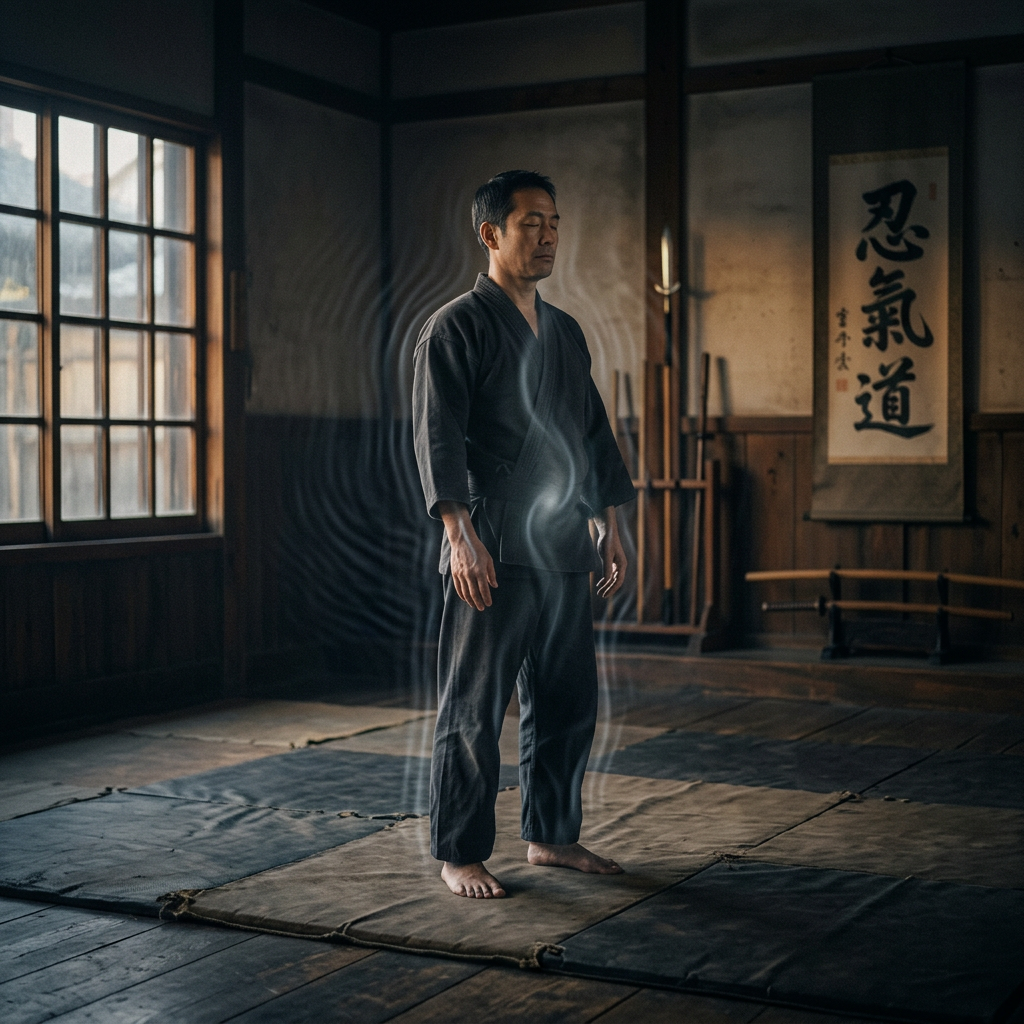


![From Shock to Strategy: Harnessing Fight-or-Flight into Surged Clarity [Part 4]](https://intuitivemartialarts.com/wp-content/uploads/2025/12/image-3-88x88.png)


