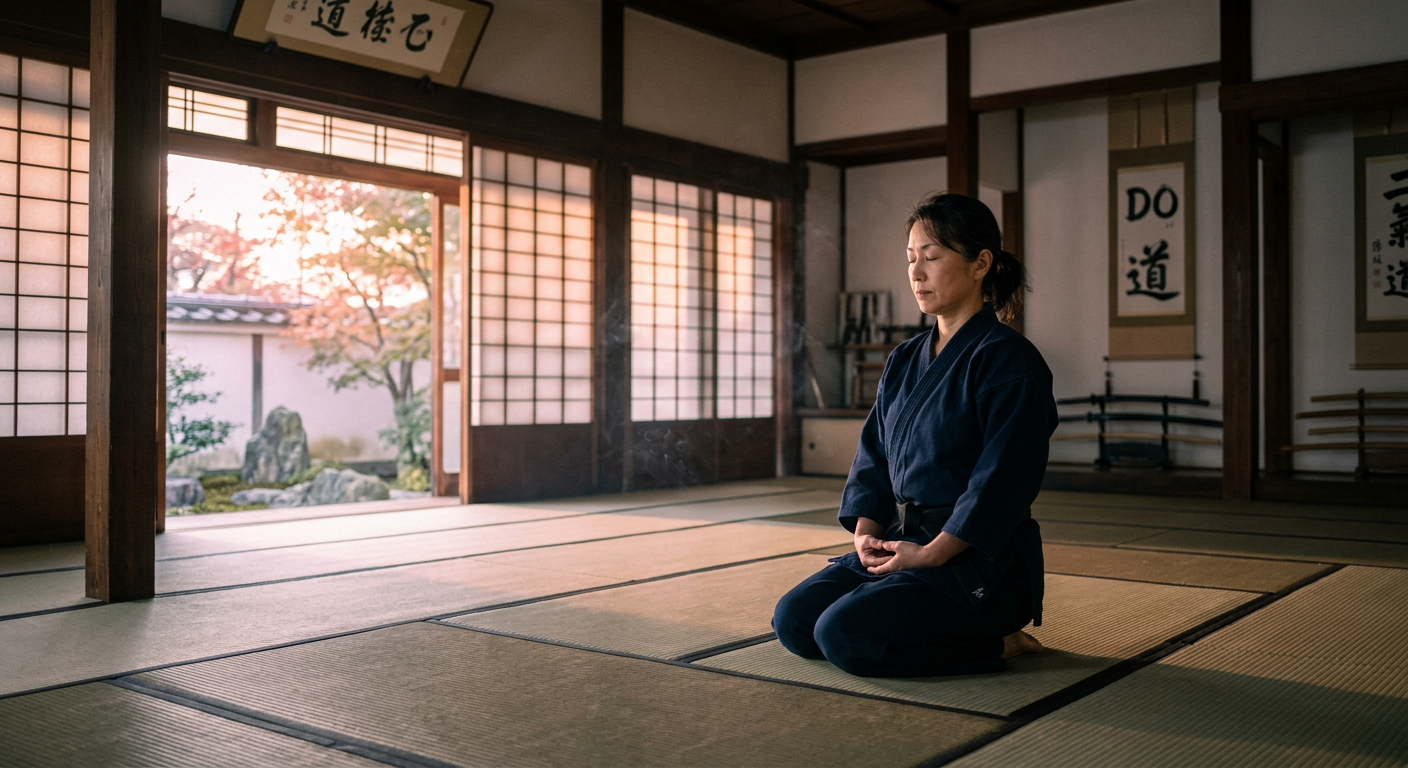
The Slow Fire: Training Beyond Fear, Thought, and Survival – Part 3

Thoughts Are Weather, Not Orders

Cognitive capacity is largely determined by bodily state. Beyond certain parameters, your emotions push, but your body’s resources can’t sustain the pressure. That is, unless you are a suitable vehicle for this energy. In terms of martial arts and self defence, developing ones body through martial arts is a method of stress distribution and energy regulation. In this way the martial artists does not suffer stress but is able to transform what would be stress one person into an enhanced possibility within themselves.

Motivation energises the system, but regulation prevents depletion.You can shift the balance from a sudden reaction to danger, which brings a kind of explosive overwhelm based on limited perception and a cognitive representation, to a more grounded and body based response. You can do this by working with breath, posture, movement. This can be done without changing thoughts at all. There may still be thoughts going on, but the contents of the brain in terms of images, sensations, and thoughts is minimal and does not disrupt your attention.

In traditional martial arts, they did not bother thinking in term of just becoming smart or technically trained. Technical details which are stored in the brain as short term memory are not the same as working with the long term neural networks. The short term memory is often an attempt to represent what is deeply understood, often poorly. On the other hand, working with an externally structured pattern and replicating that is a good way to start but after a certain point it is just recalled knowledge, rather than an expressed intelligence.

“You can look at them and use them if you want, but that’s different from imitating these surface expressions.”

In fact, many of the masters of the past urged us to ignore our thoughts and treat them as superficial, passing like the wind. You can look at them and use them if you want, but that’s different from imitating these surface expressions. There is a lot of wisdom in this, because according to martial arts thoughts are not to be enshrined or suppressed, they are just passing events, like the weather to simply observe rather than take orders from.

We think that in some way if we are strong, determined, motivated, that this will bring guaranteed health and confidence. However, it is necessary to develop your system in such a way that it thrives on what it creates in its own way, rather than relying on outside happenings and events. You then develop a strong sense of discipline and internal motivation, which when developed in the long term, brings its own kind of unique prowess to everything you do. Then, rather than because you have undergone some kind of short term competence training and recalled some impressions, you are able to generate something of substance.

So why wait for this teacher or that training method to come? Grow them from within, according to a stable platform and they will naturally develop. A fighter who engages with the their own thoughts or those of others simply hesitates and loses timing. Thus, martial arts historically trained practitioners to let thoughts arise and dissolve without engagement, keeping perception grounded in posture, breath, and the environment. Then, the benefits of training occur without changing thought content. On the other hand, you can be extremely motivated and full of technical skill but still dysregulated. Confidence from surface level competence is fragile. Confidence from a deeply held and formidable structure is stable. This is true competence.

True prowess comes from developing a system that can self-organize, self-regulate, and self-generate. In many ways, mental health is not dependant on the thoughts floating around in your head. Instead, how you engage the nervous system’s capacity to regulate attention, emotion, and action independently of transient mental representations and passing thoughts is the way foreward.

So, what I’m talking about is not just winning a fight, a match, or just getting fit. This is bricks and mortar stuff, where what you grow is inseparable from what you yield. Your thoughts and emotions might bring rain with them, which actually causes growth. rather than removing these, let them do as they will non judgementally. When I say non judgementally, this has been corrupted and can easily lead you to becoming judgemental about everything and fixate on certain things. What I mean is for you yo develop a no mind mind set.

Tomorrows skills are todays crops, which require uncertainty and contradictory conditions, like any dynamic environment in order to thrive. Thoughts, like rain, may feel disruptive. But rain feeds the soil. If the ground is stable, regulated, structured, and integrated, rain produces growth. Understand this, so that there is an interconnection between what you do and how you are, rather than letting thoughts govern action by default.

When you perform intrinsically meaningful activity, that means there is no external motivation. Yes there are external things happening, but there is no carrot and stick. If there is a thought, then there is a thought. Either way, you act as needed, not according to the thoughts going on in your head. This requires a certain clarity, and a lack of distortion of the mind. When there is no distortion, perception and attention occurs faster than thought because it happens unimpeded. It is not that you must have some thoughts and ideas to have attention. There can be attention and perception unattached to thought. In such a state, response becomes immediate, efficient, and fluid — not because thought is suppressed, but because it is not obstructing perception.

So what drives this process of perception without thought? It is simply that you remain fundamentally engaged with the activity, whether or not there is any reward or motivation. It is not that there is no thought happening. Action is not independent of thought, but it is not governed by it. Just as the crops grow without being destroyed by the rain and wind, you too grow as conditions wash over you and you continue in your growth. Growth requires diverse conditions, and thought is a necessary part of this. True development does not occur in sterile mental silence. When engagement is steady and distortion is low, the system reorganizes itself over time. Then, growth becomes continuous and perception led.

Thoughts and emotions gain a dominant influence when regulation is lost and identification occurs. Action then becomes repetitive and rigid. Thoughts then become compulsive and identity forming, rather than just informational or integrated. Mindfulness helps without changing thought content precisely because your activity is not identified with thought but with action and perception. So participation in thought becomes a vonantary process. Then, rather than your work being rewarded by relief from hardship or effort, the process is the product.

“When there is no inner bargaining, that reduces stress load and there is greater yield.”

When you voluntarily become the effort, rather than the result of some reward, this is the same as saying there is no identification with thoughts. There is no transaction, nothing in it for you. and yet, this kind of action improves mental health and wellbeing without disputing existing beliefs or relying on transient motivational states. That means there’s no pay off. When there is no inner bargaining, that reduces stress load and there is greater yield.

Why Survival Is a Terrible Default Mode

If training constantly triggers survival responses, the practitioner becomes good at panic, not endurance. So don’t drag yourself through the process just to get to the end result so that it is over. Staying grounded and centred, rather than dispersed, and in a no mind state, these are all instructions for staying out of survival mode unless absolutely necessary. Training should bias the nervous system toward modes of action that support sustained effort rather than emergency mobilisation. This means that every moment of engagement is life sustaining and stabilising, rather than survival based. You then continuously ride the wave of your own unfolding success, whether you win or lose. This all develops your ability to sustain effort without collapse, and your capacity to sustain this is a consequence of the time you have spent cultivating this process.

What you need to do is to find what uniquely inspires you. You do not need to spend hours practicing skills superficially to be a good martial artists. You will only become a technician that way. When you spend intimate time on all aspects of life, such as the meditative side, how you work, how you recuperate around training these martial arts skills, then you will become better as a result. So you can do minimal physical practice, in a disciplined and sustainable way, whilst spending time away from training. Then, all of your activity enhances the way you are. This is not the same as being lazy with training. When you become much more susceptible to growth and development, rather than just training to constantly triggers survival responses, your growth is ensured. Then, you are involved with everything rather than just a few hours of intense training at the physical level.

Fear Is Not the Enemy

Effective training prioritises sustained, regulated effort over short-term survival reactions, allowing action to arise from structure and perception, instead of cognitive overload and thought. So the idea is to get as involved in everything more broadly, just as you would with certain formal martial arts and self defence training. Then, you become fearless, because there is nothing you are not competent and involved with. This is the same as saying you are all inclusive. When you become excessively fearful, it is natural to want to dominate others and exclude them. So in dominating others, this is just a different way of identifying with fear.

When fear exceeds a person’s capacity to regulate it, the nervous system does not simply remain afraid. It seeks resolution. Domination is often a compensatory strategy for uncontained fear. This is why fear-based societies drift toward domination even when intentions are good. This is yet another example of how thoughts about activity are not the same direct perception and action. When fear cannot be carried, due to weakness and corruption, it is imposed on others. The way to handle fear is to neither deny it nor act upon it, but to work on self regulation and strategies to impede its amplification to an out of proportion state.This brings mental clarity. Clarity means the mind is not distorted by excessive narrative, emotional amplification, or self-referential fixation. Then, fear can exist without needing to control others or becoming reduced by it.

Excessive thoughts often fuel fear. So thoughts are not the source, they are fuel. When you don’t engage thoughts, you allow the fear response, which is primarily physiological, to run its natural course.Fear does not require thought to operate, and can easily become amplified and out of proportion if you allow if to command you. Fear is not the enemy, nor is it the master. By relying more heavily on becoming grounded and robust, you remove cognitive amplification of thoughts. Let fear pass through you, and you are liberated from it altogether.

Epilogue

What we call resilience may have less to do with toughness and more to do with efficiency. Systems that force people into narrow modes of functioning increase stress by design. Practices that widen the circuitry—through movement, posture, breath, and individualised development—allow the same pressures to be sustained with far less cost. This means you shift to heightened attention, without the noise and distortion. This is true of martial arts, and elsewhere. The question may not be how much stress a person can endure, but where that stress is allowed to go, as well as how you relate to a given situation. When you are able to self regulate and engage continuously, response becomes immediate, efficient, and fluid. Not because thought is suppressed, but because it is not obstructing perception. Then you do not comment on the rain, you just continue growing.

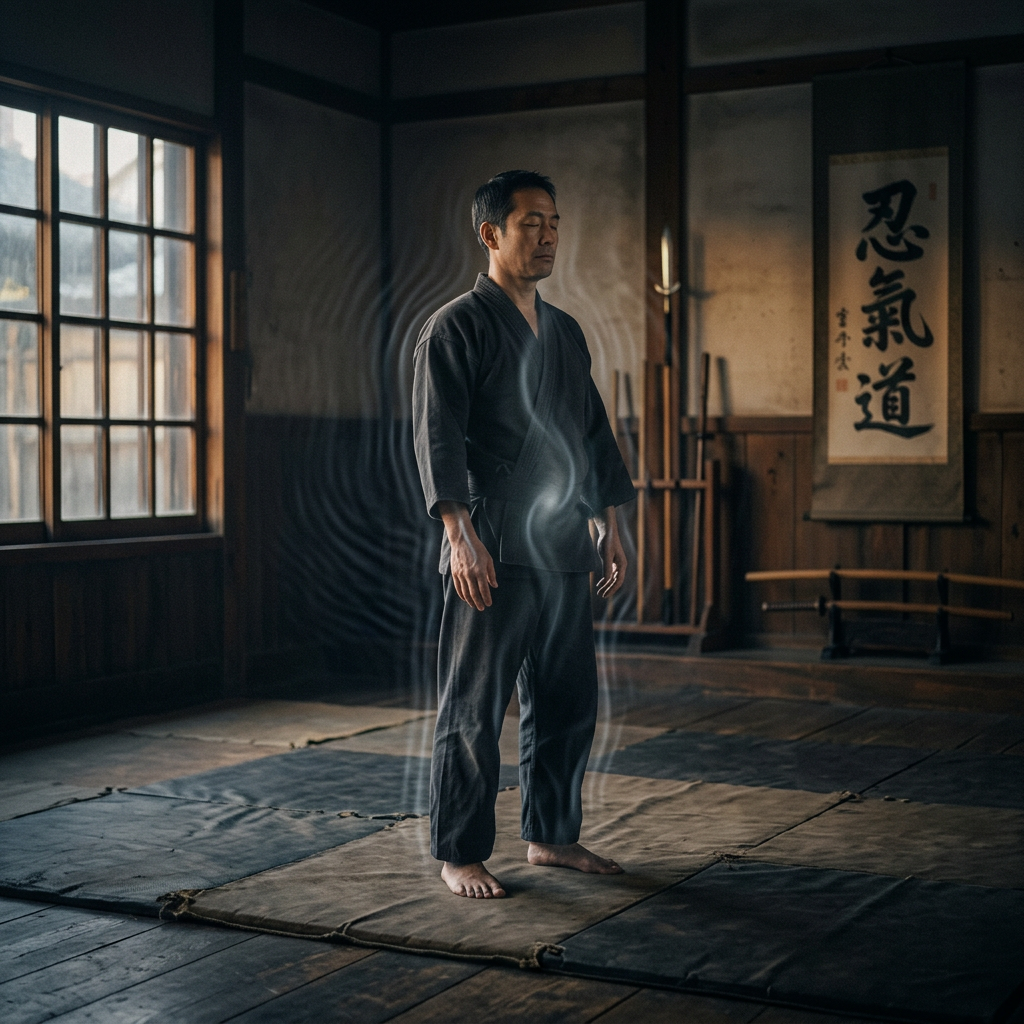
The Slow Fire: Training Beyond Fear, Thought, and Survival – Part 2

From Reaction to Regulation: How the Body Shapes the Mind

“Regulating the body is one of the most direct ways to regulate the brain, because much of what the brain does is to predict, manage, and respond to the body.”

The idea that mental health is separate from physical structure is increasingly difficult to defend. The brain is not an isolated control centre; it is embedded in a living system of nerves, muscles, bones, connective tissue, hormones, and feedback loops. Regulating the body is one of the most direct ways to regulate the brain, because much of what the brain does is to predict, manage, and respond to the body. In terms of martial arts, the work is to focus on the body through certain exercises, so that in the process you also take care of the mind.

Physical training offers a useful analogy—one that is also a direct cause-and-effect process. Bones strengthen through controlled stress and recovery. Muscles grow through breakdown and reorganisation. Movement patterns refine through repetition, error, and adaptation. Mental development follows similar principles. In addition to this, when you feel your body break down and recover, you will feel mentally more robust. I am not talking about breaking down completely, just reforming and replenishing the tissue anew, which is an entirely healthy process. Challenging misconceptions, forming new neural pathways, and reorganising perception require exertion followed by integration. This reforms neural pathways and a certain pruning of old pathways occurs.

Because the body and brain are dynamically interconnected, a substantial portion of brain function is causally dependent on bodily regulation. This includes working with metabolic, physiological, and internal perception processes. So when you work with this processes, you are actually working with both the body and mind through physical activity. This is not about emotionally charging your activity with motivational talk. With a strong intent to perform vigorous activity, you bypass motivation and go straight to energising the body. This is known as Kriya in Yogic circles, or simply working with the energy body. Rather than the body influencing the brain secondarily, the brain’s operating mode is continuously shaped by bodily state.

Without recovery, the system breaks down. Without challenge, it stagnates. Importantly, this process is inseparable from the body’s condition. Posture, breath, movement quality, and tissue health directly affect cognitive and emotional regulation. And when there is a healthy body, the signals which are sent upstream to the brain are also returned downstream to the body, metaphorically speaking. This is a circular relationship. Awareness towards this creates a powerful process of self regulation, and there is no need for emotional stimulation such as in high motivational states, which can cause burnout particularly if unregulated.

“Breaking the mind—understood not as damage, but as restructuring—is as fundamental as breaking down muscle fibres in strength training.”

There is a state called “No Mind” in Zen martial arts. Breaking the mind—understood not as damage, but as restructuring—is as fundamental as breaking down muscle fibres in strength training. It is not that you mindless go around over training and breaking yourself down physically and mentally. It is in this context that “no mind” should be understood.

Martial Arts and the Centre of Gravity

“The Hara Centre are often treated as mystical, it describes something physically concrete: the body’s centre of mass, deep core engagement, diaphragmatic breathing, and integrated posture. These aspects of the physiology can be treated as inputs to the brain, much like external inputs.”

Traditional martial arts articulate this understanding of becoming physically centred through concepts like the hara or dan tian. The Hara is the centre of regulation and maintenance of energy. While terms such as the Hara Centre are often treated as mystical, it describes something physically concrete: the body’s centre of mass, deep core engagement, diaphragmatic breathing, and integrated posture. These aspects of the physiology can be treated as inputs to the brain, much like external inputs. So when you centre your practice around a grounded posture and a developing a strong body, these often out perform purely cognitive interventions for martial arts based around performative technical execution, or even highly motivated and driven behaviour.

When stress or force is received into the Hara Centre, the system tolerates pressure more effectively. In particular, when the breathing is regulated through activity of the diaphragm, this pressure is able to be distributed effectively. For example, when there is a forceful exhale, and an engagement of the core, this signals smooth alignment of the system including the diaphragm and skeletal system into activity. This is why martial arts, yoga, and breath-based meditations emphasise coordinated exhale with movement.

“A strong exhale, particularly with full engagement, acts as a regulatory signal: it couples breathing, core engagement, and intention into a single force.”

Just as lifting a heavy object with the core distributes load and reduces fatigue, grounding stress through posture and breath spreads neural and muscular demand across the whole system. From a scientific perspective, this is training the nervous system at its foundation, not bypassing cognition or goal driven behaviour but stabilising it. A strong exhale, particularly with full engagement, acts as a regulatory signal: it couples breathing, core engagement, and intention into a single force.

As we have seen, it is important to distribute, contain, and circulate the forces of the body effectively. Without this grounding, stress remains concentrated—often in the head and upper body—leading to faster exhaustion, reduced perception, and poorer decision-making. This often makes moving the body a sluggish effort. So the idea is self regulation through movement and activity. Then, you do not need to worry about over learning the technical side of things, or being highly driven and confident about what you are doing. You do all of these things as well, but they become more of a side show.

“Just as a cake needs time in the oven to transform raw ingredients into a stable, palatable form, energy needs to “sit” in the system — contained, regulated, and integrated — to become effective, fluid, and sustainable.”

Martial arts is a whole body affair. In this sense, martial arts training is not merely about technique. Nor is it about developing the kind of cognitive load and mental saturation which is characteristic or overloading the short term memory when revising for an exam. This is what leads to stress, burnout, and a lack of self regulation. For example, during the exam there is a sense of relief and sudden expulsion of thought onto the test paper, but often not much is retained in the long term. Nor is there further inspiration to continue. This is because there is often just an immediate and tense effort. However, just as a cake needs time in the oven to transform raw ingredients into a stable, palatable form, energy needs to “sit” in the system — contained, regulated, and integrated — to become effective, fluid, and sustainable.

The Slow Fire: Training Beyond Fear, Thought, and Survival – Part 1

Ultimately, the only thing that will make you thrive in your practice, is that you ensure everything in your entire system benefits from your training. This is a long term investment, rather than a short term effort. Most forms of training involve practice according to some dominant method. The type of method changes according to the prevailing dogma, and the times we live in. For example, people might learn according to visual instruction, experiential learning, or some other method. This is ok for instructional purposes, but in the end it just leads to cliche moves and predictable cadences.

There are many ways that people learn. This is according to a variety of factors. For example, if someone is under some kind of stress, then they learn one way best. If they are more regulated and in a flow kind of state, then they learn best in another kind of way. Because the survival circuits were highly active in most people throughout much of human history, there was a strong preference for learning styles which spell everything out for you. This allowed for clean resolution. However, when one develops other centres of the brain, for example when they become older or have formed different connections, there is a need for a different style of learning, one that encourages more creativity.

Depending on the type of person, different pathways need to be taken into consideration For some, alignment to a given method is natural. Their way of thinking, perceiving, and learning happens to fit the dominant method. For others, success requires adaptation: developing a cognitive or behavioural quality that is not their natural strength. For some, there is no immediate acquisition and memory of facts. There is a more slow distribution after a sustained engagement, much like when one mediates and releases energy more slowly rather than all at once. When you can master sustained engagement, remaining present, you can find things easier and yet you perform better in many ways.

Ancient Training for Modern Stress

“If development were truly centred on human potential, there would not be a handful of learning styles. There would be as many methods as there are nervous systems.”

When one becomes meditative, there is a slow release of energy which buffers the stress response. This energy is sustained by all sorts of environmental and internal factors. Let’s say there is an environmental stimulus, which produces one unit of energy. For arguments sake, we will say that this one unit of energy can enter the survival circuits of the brain and produce a sudden explosion of activity which creates a fast and rapid response. When localised into the hara centre, the body’s centre of gravity, this same unit of energy is able to maintain and distribute energy more efficiently than if it were to enter straight into the survival pathways. This is of course simplified, but it makes it so you are able to capitalise on stress rather than be depleted by it.

Everybody has a unique capability, which if it reaches its potential, will over time produce unique qualities. So if you want to develop to your full potential and stature, you need to invest in this unique quality. Developing your uniqueness requires a qualitatively different kind of engagement. However, because people have not generally explored this, they think they should fit a dominant model dedicated towards produce pre determined outcomes. Over time, this produces a subtle distortion. People often become competent at what they are least suited for, while their more potent potential capacities remain underdeveloped or invisible. If development were truly centred on human potential, there would not be a handful of learning styles. There would be as many methods as there are nervous systems.

A key assumption in many systems is that the same stimulus produces the same response. Human physiology tells a different story. When an input enters the human system—whether information, pressure, threat, or stress—the outcome depends heavily on where that input is processed. An environmental stressor does not exist in isolation; it is interpreted through specific neural pathways shaped by biology, conditioning, posture, movement, and experience.

Why Stress Is Not What Happens, but Where It Lands

If a stimulus primarily activates survival-oriented circuits—those responsible for immediate threat response—the energy produced is fast, intense, and costly. These pathways are designed for short-term emergencies, not sustained effort. They burn quickly and deplete resources. So, if you want to focus on self discipline, and long term development, you are not primarily looking to bolster the survival circuits. Less is more in that regard.

Other neural networks operate differently when compared to the short term survival circuits. They are slower to activate but far more energy-efficient once engaged. In addition, they can be engaged for long periods without causing a depletion or energy and draining you of resources. This is the reason for the development of the more meditative exercises in martial arts traditionally, rather than just a focus on self defence in emergency situations. Then, if you need to you have more energy in an emergency, once a certain amount of energy is cultivated and refined, it is already available to you because you have cultivated it yourself.

Let’s say you react to an emergency situation with aggression. There is a sudden explosion of energy, much like taking off and sprinting to the finish line. There is a certain development of coordination, precision, and enhancement of health, but the units of energy are depleted quickly so there is no sustained long term development. There is no containment for it to become incubated and develop. This is fine in children for example, who have an abundance of energy quite naturally all the time. However, particularly as one ages, there is a need to become more efficient and intelligent about energy utilisation.

As one ages or becomes more concerned with efficiency over competitive edge, it is necessary to distribute and maintain energy, so that it can go further. This is entirely unnecessary of course if the goal is just to use up energy and dispose of it, as though it were of no value to cultivate.

So when one engages in their training with a grounded posture, sinking into the stance and focusing on the breath, one maximally engages the Hara Centre and diaphragm quite naturally. This enhance the aspects of the system which rise slowly and build steadily, with economy in mind. These systems support endurance, coordination, sustained engagement, and integration. The same “unit” of energy can be expended immediately, like a sprint, or slowly and sustainably, like a marathon. The stimulus has not changed. The pathway has. Depending on the pathway, you will take a certain kind of journey.

Stress as a Distribution Problem

“The same stimulus which causes stress can be sustained in different regions of the system, so that it becomes refined and evenly distributed rather than localised and isolated.”

In term of martial arts, stress is not simply about reacting to outside events. When you become malleable to the environment, instead of suppressing much of the system and just developing the survival circuits, you become more integrated with it. The same stimulus which causes stress can be sustained in different regions of the system, so that it becomes refined and evenly distributed rather than localised and isolated. From this perspective, stress is not simply about localised intensity within a short time frame. It is about distribution across a longer time frame.

When pressure is taken exclusively into the survival centres of the brain, the system narrows. Perception tightens, breathing shortens, posture collapses or becomes rigid, and energy expenditure rises sharply. This is effective for immediate escape, particularly in the absence of more tactical and refined methods. But it is inefficient for learning, performance, or sustained confrontation and engagement.

“When breathing shortens, the amygdala and the hypothalamus become more active, and you tend to become more emotionally reactive.”

For example, when breathing shortens, the amygdala and the hypothalamus become more active, and you tend to become more emotionally reactive. However, when you sink down into the posture, absorbing the load of the situation into the boys centre of mass, this signals stability and control to the brain. This makes you more fatigue resistant, as well as more aware of the whole body. Stress can be viewed as anxiety or fear inducing, but it can also be viewed as a kind of beneficial pressure. When handled properly, this pressure becomes a distributed process of self regulation, rather than one of narrow attention and localisation at the level of the survival areas. You are then able to benefit from anything that comes your way.

When stress is distributed through posture, breath, and movement—when it is “sunk” into the body rather than held in the head—the load is shared. Energy use becomes slower, steadier, and more economical. This is not metaphorical. It is mechanical, neurological, and biochemical.

When Experience Outpaces Recognition

“If you have put in the proper sustained practice, then maturity and full stature has to happen for you, just as others developmental stages happen naturally without permission. Readiness to accept this earns you the rank of black belt. This blackbelt not only precedes formal recognition, but it also does not need permission from others.”

The body learns before the mind is able to explain all of the details. In other words, you build an understanding based on experience, rather than theory. This is true in martial arts, and elsewhere. Let’s say, for example, you are learning to ride a bike. You are likely to fall off several times before learning to balance and stabilise yourself. In fact, learning to balance requires that you fall over a few times first of all. At the same time, you practice riding in a straight line and not falling off. In other words, it is not so much that you need to fall off to learn, but you need to accept the risks involved and learn from them if necessary. 

In terms of martial arts, you sometimes need to take a few knocks and learn from them. This does not mean you need to risk your own safety necessarily. I am not saying that getting punched and kicked repeatedly gives you the necessary maturity to become a mature person. Often, it does not. However, in my opinion you do need to take responsibility for your own experience, which may include receiving knocks along the way. Rather than outsourcing that experience to some industry approved representation of events, what you need is a certain presence within your own experience. 

Depending on who you ask, people may say that you should either seek or avoid risk. let’s say you ask a doctor about your health. They will identify several risk factors to your health, and ask you to avoid certain things. If you seek advice from a businessman, they might tell you to go for it, despite the risks involved. So it is not that authority is risk averse, or risk friendly, it just depends on who you ask. So there is no right or wrong when it comes to risk taking. When you take responsibility for the development of your own development, you accept risk and safety at the same time. This acceptance precedes authority from one vested interest group. In other words, when you develop your now judgement, then this eventually becomes the wisdom you need to make informed decisions.

“Throughout most of history, they could not afford delayed maturity or competence. Neither were there many tools to make somebody outstanding. In reality, simply accepting the reality of the situation, as it is, is in itself a way of becoming outstanding.”

Throughout most of history, they could not afford delayed maturity or competence. Neither were there many tools to make somebody outstanding. In reality, simply accepting the reality of the situation is in itself outstanding. In the past, people did not live so long or have as many years of training, and by the time they were in their 30s and 40s, they were already standard bearers and mentors to others. This was, in my opinion, a more honest way of looking at things, rather than thinking that people need to be much older before they get fully wise. It is just that, today, training and systematic thinking has tended to be seen as the only real way to develop people. However, this is merely one way of many, and it is not necessarily the best way at all. The problem with it is that systems should be made to evolve and build on themselves, rather than to just start again and ignore evolved patterns and consequences. Any evolutionary change needs to take into account these consequences, rather than just seek to ignore or eliminate them as a matter of development. 

Rather than artificially delaying and extending maturity, full stature was something that arrived not after certification and training, it was just expected to occur quite naturally. There are obviously environments which are conducive to this seasoning happening in the best way possible. For example, an environment which has enough members in it that have accumulated insight is superior to an environment where age means decline. In some ways, age often means decline of course, but it means more than that. Systematic or structural systems often tend to treat experienced people as non compliant or out of step, rather than whole people with developed insight. This is a generalisation, of course, but it is often so. 

Today, we often find ourselves in a strange situation where we accumulate experience, but hesitate to embody it fully. We continue to defer to experts long after we have reached maturity. It is not a bad thing to defer to experts in certain contexts, such as when deciding which course of treatment to take at a hospital, for example. But there are many areas of life where one can have the necessary expertise and experience just by virtue of naturally arriving at maturity and competence in terms of life experience. This is not some anomaly, but is actually quite natural.

Some understanding can only be arrived at by sustained attention, as well as honest appraisal of one’s own life experience over time. This sustained effort does not rely on guarantees or reward or meeting objectives, nor does it lead to the completions of goals. If you can sustain your attention towards life, rather than all the details in the happenings surrounding life, then you can naturally develop the raw materials to flourish naturally and reach full maturity. These raw materials naturally develop themselves along a certain trajectory of lived experience. This process does not require societal permission, it just requires awareness of reality in the full sense. 

“Wisdom doesn’t switch on in old age. It is instead claimed by one who is able to see the emerging reality in front of them in the fullest possible sense.”

Wisdom doesn’t switch on in old age. It is instead claimed by one who is able to see the emerging reality in front of them in the fullest possible sense. This can happen at an advanced age, or just at a certain point of maturity, for example, in one’s thirties and forties. This emerges over time naturally. Historically, people were expected to step forwards rather than recede into the background once their narrow usefulness had run out. Today the reverse is often true, and one often finds themselves irrelevant in places where peoples are used as raw materials rather than as peoples to bring up to full stature.

“When martial arts is full of energy, in all of its possible varieties, it becomes dynamic and unpredictable. Then, there is presence and engagement, there has to be, it is inevitable.”

If a martial artist retires from competitive training, they often simply exit the community. At best, they become an instructor of a technical and systematic approach to martial arts. This is one reason why martial arts can easily become overly dogmatic and ritualistic, out of touch with the evolving environment. However, when martial arts is full of energy, in all of its possible varieties, it becomes dynamic and unpredictable. Then, there is presence and engagement, there has to be, it is inevitable. Ritualistic training, where everybody is doing the same thing at the same time has its benefits in the right context, but today there is so much variety and diversity, that it often becomes irrelevant. 

It is often better that people develop in their own way as unique individuals. This requires a level of discipline that is often missing in many people. However, when one is able to develop as a unique individual in the best way possible, they are an example and a nurturer of others to do the same, even though they are not a perfect representation of systemic design. However, in rigid systems, rather than imparting what they have learned, experienced martial artists are usually expected to stop developing and simply stand above others to be looked up to as a finished product. However, one does not get to a point where they have all the final answers freezing into an authority, they stand where they are fully, amongst others rather than on top of them. That way everyone is always in the making, evolving fluidly rather than in friction with one another. 

Embodied competence precedes recognition. This includes your own recognition, as well as that of others. If you have put in the proper sustained practice, then maturity and full stature has to happen for you, just as others developmental stages happen naturally without permission. Readiness to accept this earns you the rank of black belt. This blackbelt not only precedes formal recognition, but it also does not need permission from others. Waiting for the formal kind of endorsement often just delays the inevitable, and the inevitable only happens through sustained use and employment of your faculties on the right kind of pathway. Then, it is only natural that your competence emerges, and hesitation surrounding this natural development has its own consequences. 

One needs to be functional in real time, not just when it suits some establishment. Deferral of this proper functioning is a luxury you cannot afford, rather than a necessity that you must oblige. What I mean by that is, if you are training according to what is necessary, rather than all that is unnecessary, then you naturally arrive and there is no waiting around or deferring of your peak maturity. When you have already arrived, then there is no more to do than to do as needed. This arrival is simply there in your presence. No amount of following of a process can replace this awareness of being present. 

At a certain point, you stop copying others and putting them above your own development, above your own flowering. Instead, you start carrying the responsibility, and this responsibility becomes a reference point for others as well as yourself. You might say that this is a heavy weight to bear. In fact, it is not, it is just the way things are. Then you move from being above others, which carries its own challenges, to transmitting your insights because of your depth of experience, which is an enriching experience in itself. Rather than out of your power or influence over others, which requires conflict with others, you accept them and yourself as a kind of ecosystem. This is not a perfect powerful authority, it is instead a sincere and authentic authority of responsibility. 

In the context of martial arts, refusing to take this responsibility is seen as unethical, once one arrives at a certain point. The reason for this is not to pressure people into some system or position in the hierarchy, but because one must eventually stand by their own experience and developed capabilities rather than against it. When I say this, I do not mean some egotistical image of an authority that you have made for yourself. This is a delusion. Formal recognition of your authority should follow natural development, rather than you trying to live up to an image. 

“Formal recognition should recognise reality and seek to conform to it, rather than replace its richness.”

An image is something you or somebody else has made up, and has no existential relevance here. In other words, formal recognition and titles should not replace life experience. Formal recognition should recognise reality and seek to conform to it, rather than replace its richness. So in the end, martial arts teaches you that readiness is proven in capability and action, rather than grounded in the opinions of others. 

Six Timeless Key Principles of the Martial Arts Stance – Part 2

Last time in https://intuitivemartialarts.com/2025/12/30/six-timeless-key-principles-of-the-martial-arts-stance-part-1/ we started to look at certain internal aspects of the stance which are important in martial arts. Now, we will look at this further by covering the next five points.

Body Alignment and Posture
The torso is slightly side-on to extend the reach of the lead hand and maximize the power of the rear hand. The rear hand is held back so that it can generate velocity as it travels forward. As we have already seen in part 1, the right hand is on the Yang side, responsible for powerful and direct attack. The Yang side does not need the immersion that the Yin side does, so the Yin side is often forward so that it can act as feeler of the situation in front of it.

The chest is lifted to allow proper lung and diaphragm expansion, while the shoulders are rounded defensively and the chin is tucked for protection. This combination of rounded shoulders and lifted chest keeps the torso from collapsing or concaving. The neck is activated to transfer energy from the shoulders to the head and enhance perception. In the next section, we will look at how to position the head via the neck. Basically, this proper alignment creates a balance between protection, flexibility, and readiness.

There are multiple ways to produce the same result. Certain gases—carbon dioxide or water vapor—can come from biological or geological processes. The result looks the same, but the cause is different. Energy in martial arts works the same way. What looks like strength or power isn’t always coming from muscle. Often, it comes from alignment, movement, and positioning. It all depends on where your attention is placed. This is why, according to traditional martial arts, so much emphasis is placed on how you hold yourself within the stance, rather than just paying attention to the smaller details separately.

Hips, Spine, and Energy Flow
The hips are simultaneously lifted and grounded, allowing both stability and mobility. The spine acts as a conduit for internal energy, running from the base to the head, creating buoyancy without losing grounded power. The body’s energy flows along this “golden thread,” as Chinese systems call it, keeping movements rooted in the center while allowing them to extend outward effectively. The Golden thread is said to start from the base of the spine and around the Hara Centre (the Centre of mass), and then terminate at the crown of the head.

As we alluded to earlier, attention is key. Energy in martial arts can’t be reduced to one domain alone. Sure, chemical energy and biological processes are part of it, but energy expression in martial arts isn’t just one output. For example, if you have a bigger physical fuel tank (cardio vascular system), you do have an advantage in certain ways. However, there are people who, if they maintain the right kind of environment within themselves energy wise, never easily tire. It is as if they have an extra pair of lungs. This is because they have produced energy within themselves in an entirely different way.

Retaining functional alignment means you don’t tire easily and can adapt quickly. Proper alignment dramatically increases energy efficiency and transmission, even if you don’t have large reserves of it. greater efficiency and transmission gives greater scope for expression and a heightened felt sense of energy. You can do more with less. This is why in traditional martial arts styles they were always prim and proper.

Many people tire quickly in simple exercises because they focus only on muscular strength or specific fitness aspects alone. This can give them a boost at first, but you need more than this after some time because one tends to get less inspired as time goes on. You need more than just functional fitness past a certain point. When you lack inspiration, this makes the body heavy and can put you in a state of hypervigilance over minor details, internalizing stress and feeling inadequate.

Fluidity and Movement
A proper stance is intuitive, not mechanical. You don’t act just to fill the moment—the space itself carries information. Anticipation comes from restraint, not from rushing to fill the space with your own ideas. This is why traditional martial artists could wait for long periods without stagnating—they learned from the space, not from forcing movement into it. Living in this time and being rooted in its information is essential before acting if you want to get the mos tout of martial arts practices.

Angles, distances, and foot positions should feel natural, not rigid. Hands stay flexible, ready to punch, grab, push, or shift weight. Movements flow seamlessly, without unnecessary gestures, allowing internal stillness to manifest externally. This fluidity, which is an aspect of yin, prevents predictability and keeps opponents off-balance. So paired with yang, you become extremely active as well as perceptive.

Inner Focus
Stillness in the stance isn’t passivity. It cultivates inner attention and concentration. Maintaining awareness under external stress ensures clear perception and energy control. Above all, it keeps stress an external factor rather than an internal consideration. When you deal with it on the outside, there is no mistaking external stresses for being part of who you really are. This distinction is often missed in the more external styles of martial arts we see today, which rarely do enough to create a distance between oneself and the external. In fact, managing stress after cultivating it often becomes a bonding exercise and form of emotional labour, which attaches itself to practice.

This wider awareness I’m talking about, is the ongoing seeking of information from the situation as it is. I’m not talking about becoming more aware of all the artificial limitations of practice and trying to calculate all of this. Internalize the essence of the environment, not all the distracting details. Then, you become like the sea, moving of its own accord absorbing anything into it. And if someone skims a pebble across your surface you don’t change your rhythm.

Awareness of the throat, spine, and diaphragm integrates physical and mental energy for maximum efficiency in defence and attack. Slightly looking upward while rotating the neck forward (chin slightly tucked) keeps the cervical spine neutral, reduces strain, optimizes posture, and keeps the airway open. Earlier we looked at the important relationship between alignment of the head and body. Tucking the chin prevents overextension of the upper spine, protects the jaw, and activates neck muscles connected to shoulder and upper-body energy channels. Round the shoulders slightly while lifting the chest to keep the torso light, buoyant, yet grounded—ready to move or strike without strain.

Technical adjustments alone are less effective than a stance informed by internal awareness, energy, and intention—the faculties you already possess. Anything else belongs to external martial arts: technical aspects, stress, tension, anxiety. You can’t beat anxiety or stress with internal martial arts—you operate outside their influence. Avoid cluttering internal space with busy activity or over-fixation on external form.

Biomechanics and Practical Principles
Fundamental mechanics are consistent across martial arts. The big toe grounds you; the thumb directs hand control and punching strength. For example, as you corkscrew the punch inwards via the thumb, this creates a kind of centrifugal force in conjunction with the extension muscles. So there is alignment, motion, and energy are going on at once. As the fist rotates inward, the thumb’s alignment stabilizes the wrist and allows the forearm’s turning to occur smoothly and with the right poise.

In terms of the foot, you sink the weight into the heels and press into the big toe. Pressing into the big toe allows you to extend through the posture as well as concentrate the weight there. In the lower body, sinking weight into the heels while maintaining pressure through the big toe creates a dynamic balance between stability and mobility. The heel accepts vertical load, while the big toe provides directional control and propulsion. Pressing into the big toe activates the muscles of the posterior chain—the rear leg region—allowing the body to lengthen upward even as it settles downward. This produces a full-body stretch through the entire posture when practiced correctly, not as passive tension, but as elastic back and forth momentum.

All of this means that you get full stretch through the entire postural chain, because you are at once concentrating the weight, energy, and pressure into the big toes, which naturally encourages an equilibrating force at the top of the posture.

Because weight, pressure, and muscular engagement are concentrated at the base, an equal and opposite force emerges at the top of the structure. The spine naturally lengthens, the head balances, and the arms are freed to move with speed and precision. This is why effective strikes feel “light” at the extremity but heavy at the point of contact: force is transmitted efficiently through alignment and timing, rather than effort being generated locally. Put simply, you feel the pressure where it is concentrated and the release where you are light, but there is balance across the whole system. This is why according to traditional and internal martial arts system, one maintains a lightness of the upper body and a certain pressure within the core region, creating an overall balance.

Effective stance and movement combine physics, biology, and energy flow—not just form. Formalities are dissolving, because authority itself is eroding in many instances, so make sure your practice continues uninterrupted.

From Shock to Strategy: Harnessing Fight-or-Flight into Surged Clarity [Part 4]

The mind should be clear thinking and you should remain aware. In this way the quality of your behaviour rises to such a level that you are able to act properly without turning the power up to the max suddenly. When adrenaline then hits, it is just a bonus.

Any martial artist will tell you that power comes from a relaxed state. This is because there is a steady current which is working as it is, rather than needing any kind of external stimulation to get it going properly. So the mind should be clear thinking and you should remain aware. In this way the quality of your behaviour rises to such a level that you are able to act properly without turning the power up to the max suddenly. When adrenaline then hits, it is just a bonus. Put differently, your behaviour is at maximum capacity without being artificially high in any one dimension. It is for this reason that when it hits the fan, the martial artist is already doing something intelligent when they get an additional boost of adrenaline.

Let’s say you have a pair of speakers. If the speakers are high quality, you can clearly hear them at volume level 30. Another pair of speakers needs to be turned all the way up to 100 just to hear what’s going on.

Most of us grew up with the idea that stress helps us perform. But this only allows you to act in specific ways at an high level. For example, however you are get’s amplified in some way. Let’s say you have a pair of speakers. If the speakers are high quality, you can clearly hear them at volume level 30. Another pair of speakers needs to be turned all the way up to 100 just to hear what’s going on. They are low quality, and one dimensional in terms of sound At the same time, there is a lot of unpleasant noise and interference going on with the bad but loud speakers. On the other hand, all of the supply lines and working properly in the quieter set of speakers, not just one or two circuits. Because of that, you get a balanced, regulated, and natural sounding output. It is the same thing in martial arts.

When there is a love for whatever you are doing, and the reflexes and basic fundamental skills are there, I think you can perform a lot better and with less emotional volatility. This love for what you are doing replaces the need to become dominant over others and increase the voltage in a volatile way. For example, when you love what you’re doing, dopamine release becomes tied to mastery and meaning, rather than external reward or reaction to external stimulus. This will at least bring down the need for craving stimulation from the sudden onset of environmental cues, in order to get the system up and running properly.

In terms of martial arts, rather than hyping yourself up and glaring at people insistently, you can disarm somebody completely by the way you are. You can walk through the situation rather than feeding it. Then, the simple act of remaining physiologically relaxed and disciplined is enough to diffuse hostilities instead of butting heads and puffing your feathers. This is known as fighting without fighting. Even if for some reason there is still a great need for external stimulation, or you are addicted to certain behaviours, building a solid foundation for internal reward systems can greatly reduce this need over time.

You should act before such thoughts arise by having everything within your gaze and fixating on no detail in particular. This is how the way you look at people can influence your physiology and theirs.

You should not think “That guy is staring at me, I must act”. You should act before such thoughts arise by having everything within your gaze and fixating on no detail in particular. This is how the way you look at people can influence your physiology and theirs. When yo are broadly aware but not reactive, you can then shift the gaze seamlessly so that you don’t cause other people to see you as some kind of hostile competition. When you remain aware before some kind of emergency situation arises, you do not need to suddenly boot up. You only need to do this if your system is switched off or has collapsed for some reason. If you are steadily active, you not only are better at defending yourself, you are better able to absorb the energy of the situation so that you and it are one and the same.

Flowing Into Strength: Stability Through Continuous Awareness

A dead and inert tree would simply be blown over by a gust of wind. A strongly rooted and vibrant tree would absorb some of the energy from the wind, sway with it, and its roots would even benefit from the pressure exerted upon it by getting stronger.

When you overall system is balanced in in tune with the environment, there is a completely different response to emergency situations. First of all you are not shifting from zero to one hundred. You are also better able to withstand pressure. Let’s use the example of a tree. A dead and inert tree would simply be blown over by a gust of wind. A strongly rooted and vibrant tree would absorb some of the energy from the wind, sway with it, and its roots would even benefit from the pressure exerted upon it by getting stronger. In the same way, the martial artist sinks deeply into the posture and absorbs the energy of the situation, remaining flexible in body and mind.

The thing to remember is that when these self defence systems were devised, life expectancy was low in most cases. For example, in China life expectancy was around 32 years old as early as one hundred years ago. Obviously, the Chinese systems were developed well before this, when life expectancy was even lower. In other words, the kinds of survival responses needed when life was much harsher was a lot different to what is needed today. So martial arts in the modern day must be viewed in this context.

Conditions today are not as tough as they were in the past. Although we have learnt to complain about everything, there is not such a need for constant survival mode all the time. At the same time, if you don’t look at how things were done, you don’t have the drive to do better. For example, there would be no need to live well if you didn’t take care of the need to survive. In fact, living well is built upon a good foundation of survival which is proportionate to need. The tree grows out of a mixture of turbulent environmental factors as well as a steady supply of life sustaining energies. In the same way, the martial artist is able to empower themselves through turbulence as well as energy cultivation, which are always linked.

If a tree was in survival mode all of the time, there would be no flowers fruit. The survival aspect is the foundation, the root. There’s a lot of digging around and feeding going on there, at the root level. So the survival instincts can be seen as a moving foundation, rather than a secure structure which is fixed. The secure structure, which is fixed, is built once there is a strong foundation for survival to happen, which is fluid. So in order to fix yourself strongly, you must remain fluid yet immoveable.

From Shock to Strategy: Harnessing Fight-or-Flight into Surged Clarity [Part 2]

The body does not distinguish between overload or inertia, the quickest way to boot up the system is through the survival circuits.

In the previous post, we already looked at how fight or flight is expressed differently for different people. In order to reclaim fight or flight so that it is a more focused power, one thing is to remain switched on, but not hyper vigilant. If you are switched off completely, there is no hope of doing much of anything meaningful. To compensate for this off state, the amygdala will be overloaded the moment an emergency situation presents itself to you. in fact, the emergency response can happen due to overactivity or under activity of one’s attention.

Let’s say you were zoning out and then suddenly a certain situation triggers your fight or flight response. You would go from zero to one hundred just like that. On the other hand, if you were hyper vigilant over something, anxious about it even, then fight or flight would happen out of that. So there can be an unwillingness to prepare properly, creating a deficit, or there can be a total lack of awareness. In either case the void of energy needed to mobilise for action will be filled by the survival circuits so that you become primed for action. This can be helped by harnessing other aspects of the system, such as awareness, so that fight or flight happens to that too, not just the survival circuits.

This has nothing to do with psychological misinterpretation of threat, the biological response to the void is very real. If you are under powered, fight or flight hypes you up. If you become one dimensionally aware of only your own immediate physiological needs, then this constriction of awareness creates an artificial sense of emergency. So the only way out is to remain aware of more than your immediate needs, the bigger picture, whilst remaining in a balanced state as much as possible.

With something as simple as catching a ball, you could jump out of your skin and fail to catch it if you were switched off or too tense. The body does not distinguish between overload or inertia, the quickest way to boot up the system is through the survival circuits. This explains why people who get struck by inertia end up in a similar state to burnt out people. If higher intelligence fails, which involves wider awareness and sense perception outside of immediate needs, survival takes over. If there is no survival instinct, fight or flight kicks in and fills the void also. This is simply the quickest and most efficient way for your system to get things going, which has worked throughout history.

Under powered or over powered, it just means lack of overall balance and nature takes over.

There needs to be a certain level of survival activity for there to even be a heightened intelligence, or a greater well being. This is important, because if you become either overpowered or too dim, the survival process initiates to prevent collapse or a vacuum being created. Under powered or over powered, it just means lack of overall balance and nature takes over.

It doesn’t matter whether it is the mind or emotions, if there is a deficit somewhere, the brain tries to keep up in the most efficient way, by reacting and powering the survival circuits to give you a boost. At the same time, this boost has its own consequences. Boredom turns into irritability, and emotional outburst often follow overindulgence. In other words, excess has its costs, and when something as costly as a survival reaction kicks in, there are usually deficits later on in terms of energy.

It is possible to make yourself in such a way that you supercharge aspects of yourself which generate the best returns. That way, you benefit from any kind of high energy state because you are ready for it.

Mental burnout leads to inactivity, in the same way as lack of purpose leads to restlessness. In other words, overactivity and under activity are two sides of the same coin. However, it is possible to make yourself in such a way that you supercharge aspects of yourself which generate the best returns. That way, you benefit from any kind of high energy state because you are ready for it. If you are adequately prepared, you are not caught out and surprised, you process everything clearly and act accordingly. This involves planning and preparation, and applies to sport as well as emergency situations. The idea is to think clearly, but not overthink, whilst acting as needed rather than underacting.

Gracefully catching a dangerous hammer being thrown at you uses the same internal wiring as flinching away from something desperately. The quality of expression is different in both cases, and they cannot happen ate the same time.

Rewriting the Reflex: Overlaying Mastery onto Instinct

If there were a hammer being thrown at you, you would be injured by the thrower if you were unprepared. Gracefully catching a dangerous hammer being thrown at you uses the same internal wiring as flinching away from it desperately. The quality of expression is different in both cases, and they cannot happen ate the same time. This is the reason for the beautiful forms which have arisen in martial arts. They wanted to capture this beauty in order to develop a different kind of energy within a survival situation. This enhanced energy could then be used just as potently as a desperate survival response within life threatening situations. This is why there was always an insistence on discipline and striving for more.

If the sprinter did not warm up, they would be able to produce the same power in a different way. None except the essential pathways for running quickly would be active. This would lead to diminished performance in the long term even if they got through a race or two without injury.

So there is no problem for someone who is ready to catch or even juggle a hammer. This is because they have prepared themselves, like a sprinter prepares themselves for a race by warming up the neurological pathways before hand. This turns a reflex action into an expression of self mastery. By warming up and getting ready beforehand, the sprinter is able to run gracefully as well as effectively, without overthinking or trying to warm up whilst running the race at the same time.

If the sprinter did not warm up, they would be able to produce the same power in a different way. They would be running in a desperate state, trying to warm up, prepare, and run the race all at the same time. This type of race can only be run in a state of reactivity, rather than complex and dynamic planning and execution. the survival response traditionally spreads resources thinly, so that nothing can be done optimally. None except the essential pathways for running quickly would be active in the purely reactive state, and these pathways would be doing the job chaotically and inefficiently. But they would get it done in a messy way. This would lead to diminished performance in the long term even if such a runner got through a race or two without injury.

Let’s say you become tired and irritable, and then someone annoys you in some way. All of a sudden you get flooded with adrenaline and kick off about nothing. If there is a steady supply of energy to those pathways which can become overreactive, such as the amygdala within the brain, then these sites do not race from zero to one hundred as soon as it kicks off. This involves activating others site’s, so that the adrenaline does not flood into one active place but across many pathways. For example, if there is activity of the prefrontal cortex, as well as other regions, then you end up in a more balanced and regulated overall state when survival kicks in. This leads to a more intelligent response, creating a greater sense of balance across several areas. Because of this greater intelligence, you are able to exert more and more control over your situation.

From Shock to Strategy: Harnessing Fight-or-Flight into Surged Clarity [Part 1]

It is said that the enemy can be held at bay and under control only by superior clarity, which becomes a skill and a form of strength. Then, even when the enemy is in front of you, their onslaught can be withstood.

You’ve probably heard people say in martial arts “Stay calm under pressure”. The moment you become reactive and powered by stress, you are liable to do something stupid. You also become very forceful immediately. However, when you decide on a clear intention, which you stick with unwaveringly, you organise the mind beforehand. with this clarity in mind, you are not trying to organise, fight off, and adapt all at the same time. The idea is to not be too reactive to the immediate presentation of things, or too under active, but to remain balanced.

You want the lights to be bright enough to see, but not so overstimulating that you forget to even breathe. This is what happens when the system fires up all of a sudden, certain faculties get diminished whereas others supercharge. It is said that the enemy can be held at bay and under control only by superior clarity, which becomes a skill and a form of strength. Then, even when the enemy is in front of you, their onslaught can be withstood. Reactivity to the situation brings one kind of strength. On the other hand, when you bring superior organisation and clarity of thought to the situation, this brings another kind of energy and strength entirely.

Stress triggers activity in the amygdala, the brains survival region. The survival circuits themselves are not designed for intelligent activity, but to initiate fight or flight. in terms of evolution, superior sense comes after survival has been ensured. When it comes to brain functioning, intelligent functioning can only be achieved if the survival circuits are kept within certain parameters. In other words, in an all or nothing survival response, it is beneficial to have some investment in intelligent action. Otherwise, you might over react for no reason other than because this is the only investment you have set in motion.

The work of the martial artists is to maintain their survival instincts within certain parameters, and constantly adjust and attune themselves to the situation as it unfolds in front of them. This means they do not get over reactive or under reactive. For example, when one succumbs to inertia, it is a good idea to do some training and activity. This need not be physical activity, it could simply be making more of an effort to remain attentive and switched on to the environment. Otherwise, without ramping up the system in some way so that it sits within certain parameters, you may be triggered into reactivity by outside events more than is necessary. On the other hand, when one becomes over stimulated, it is a good idea to sit and bring agitation levels down.

Fight or Flight as an Empowered State

The fight or flight response happens in everyone, but it is expressed differently depending on how you handle your own internal situation. If you keep yourself properly maintained, in a balanced and coherent way, then you are able to process everything clearly and take effective action. At the same time you get an injection of energy. Then, there is a good balance between attention and processing, which then gets powered up. You then know what’s going on properly, and you are in a better position to respond accordingly instead of simply reacting. When danger comes, you are then hit with less psychological shock because you see the whole picture clearly, and you are more stable. Let’s see how this works.

If you can grow and swell with the situation as it unfolds, expanding when needed without bursting your banks, you can learn to benefit from high pressure situations.

A person who relies on getting hyped up and stressed at the last minute, is fragile the moment things don’t go their way. Take the example of the boss who leaves everything to the eleventh hour and then bursts into a fit of activity. What should have been done over several hours is done all at once. This is because they have not prepared themselves optimally. On the other hand, if you can grow and swell with the situation as it unfolds, expanding when needed without bursting your banks, you can learn to benefit from high pressure situations. In many ways, this involves broadly assessing the situation without multi tasking and spreading yourself thin, as well as remaining aware but not hyper vigilant. You are then not trying to do everything at once, and do not become hijacked by the survival circuits of the brain. Instead, you remain dominant over the survival circuits, putting them in their rightful place, because other features of the system get powered up.

In terms of martial arts, if you remain balanced you are then much less likely to make poor judgements and make the situation worse. When you keep yourself balanced and regulated, the situation is in your hands, and you can use such situations as a tool for your own development, making better decisions. The additional adrenaline of fight or flight is then like a ball being thrown to you, which you absorb into your hands. Rather than the ball bouncing out of your hands before you absorb it, or fumbling about with it, you just take possession of it. Instead of being taken by surprise, there is a sense of anticipation. At the same time, too much calculation and overthinking actually causes people to miss the ball entirely.

The mind is able to declare that just about anything is a threat to survival, making you unnecessarily reactive to external situations. The survival response is not conditional upon their being an actual serious situation. This explains why people who overthink things, even small matters, can easily blow them out of proportion or miss something vital, even though they become very insistent or forceful. The vital thing they miss may be quite subtle but can make a big difference in the end. This is why it is important to remain attentive and aware of the situation as a whole. Then, you can see that which is not obvious, expanding your sense of the whole as well as the yet unknown. In this infinite game, you carry on noticing more and more in life that you previously didn’t get, broadening your consciousness.

Each Breath Stirs the Tides, and Each Heartbeat Shapes the Shores.

“In terms of martial arts, this ecological growth means internal renewal and overall health improvements over time. So there is an incubation period which fleshes your system out as the energy settles in. It is not just a case of flooding yourself with hormones so that you can dissipate them in some kind of activity.”

In martial arts, people want to practice in such a way that they become physically capable and healthy, as well as mentally balanced. However, in practice this often does not happen in any meaningful way. When you look around, most of the martial arts styles out there are teaching tricks to get you out of a sticky situation. Or, they are teaching you to take part in some kind of elite sport which has no meaning outside of competitive circles. Whilst it can be beneficial to practice these tricks of the trade some of the time, most of it can be learned fairly easily, even on the internet.

In terms of output and fitness, the activity levels have gone up, but the internal development has not”

A few years ago, learning something like karate or Taekwondo meant you had to go to a dojo. Even then, most people quit without learning much at all. Today because all of freely available technical information which is so easy to find, you see lots of people able to punch, kick, throw, and all sorts of other things. The information is much easier to obtain and people are able to do these things even if they have never been to a formal class. Going to the class should create a conducive atmosphere in which you learn to develop as a person. However, all we see nowadays are classes packed with people going through the motions or getting hyped up and excited into activity in some way. So it has taken on the character of a nightclub in many ways.

The idea behind martial arts is to empower the internal side of the human being, not just to cover their external requirements. This is not happening at the moment on any large scale, even if there are more frequent training opportunities. So in terms of output and fitness, the activity levels have gone up, but the internal development has not. Without upgrading the internal side, the external activity will not develop in a self sustaining way or become meaningful to the individual. As people go through the motions, the body will just accumulate injuries and other stresses which will wear it down over time. This is what happens when martial arts turns into a competitive sport or business enterprise in the market place.

Just as the minerals from the sea rise and spread across the land, bringing nourishment to support plant growth, the hormones produced from the gut and elsewhere are distributed across the body to facilitate growth and repair.”

When you perform powerful activity, such as in martial arts, it is important that the energy is delivered from core of your being, extending itself more widely from there. Every action you perform has an impact on your own internal health and well being. During strenuous martial arts activity, the bloodstream delivers hormones to the organs and tissues, just like a river delivers water to the land. This ensures growth and renewal as the process of self development unfolds. Just as the minerals from the sea rise and spread across the land, bringing nourishment to support plant growth, the hormones produced from the gut and elsewhere are distributed across the body to facilitate growth and repair.

The gut is like the deep ocean vents, the activity of it creates currents and forces which lead to environmental change. This environmental change leads to ecological growth. In terms of martial arts, this ecological growth means internal renewal and overall health improvements over time. So there is an incubation period which fleshes your system out as the energy settles in. It is not just a case of flooding yourself with hormones so that you can dissipate them in some kind of activity. Doing so just puts you back to square one. Each individual will act according to their needs and compulsions. This might mean that some energy is allocated to physical activity, whereas a certain amount is also allocated to spiritual growth. For some people, martial arts means just moving around and expending energy. To others, there is more of a transformational element to it which ends with internal development.

Today, lots of people talk about medical interventions to correct poor health without any idea about how to kick start the internal health process. In many cases, these interventions can also be used to support internal growth, rather than constantly relying on external supplements. Internal martial arts means you manage your state of health from within, with or without outside help. According to the internal martial arts perspective, external supplements or external activity is just a way to trigger or kickstart the system predominantly. You can then do anything in a positive state.

Once you reach a state of good health and well being, you know by inference how to manage this and what to do as time goes on. It is like when you get to the age of thirteen or so you automatically begin to understand why people generally get married and start a family. This does not need to be taught by strangers. At the same time, there is guidance needed. When you study life closely, rather than just what is written about it, you naturally become aware of how to manage things.

Exercise, digestion and stress, all trigger hormonal development. In order to prevent dissipation of this internal energy, you need to a get a wide spread happening.

Martial arts schools these days are managed in such a way that you train in the evening and then flop in front of the television by the time you get home. So there is often no momentum gained from spring boarding yourself into activity during the martial arts practice. Most of the time a martial arts school means a recreational activity, so it is not quite right to call it a school. In any case, the norms of society are the same, you work hard and then you relax by drinking alcohol or taking intoxicants to subdue the system again. Otherwise, without the necessary teaching, people tend not to be able to sustain higher levels of energy for long without burning out. When people try to manage high pressure and energy states for prolonged periods of time without the necessary personal development, it is only natural to get into emotional upheaval trying to manage their overall situation.

Exercise, digestion and stress, all trigger hormonal development. In order to prevent dissipation of this internal energy, you need to a get a wide spread happening. If you are just enjoying the effects of your hormonal system as it is, then you are not creating anything new out of it. For you to exploit it as it is, it needs to stay as it is. This is fine, but the human system is capable of immense possibilities when you link the different parts of the system together in dynamic ways rather than separating things out for limited functioning. For example, just as the rising seabed pulses waves across the shore, the bloodstream has far reaching potential which can nourish and regulate the body. In Chinese martial arts, the Qi energy is said to circulate vital energy through the meridians and across the body. In modern terms, the hormonal flow mirrors this subtle current.

In the Eastern martial arts system, the subterranean forces are said to emerge from the depths, bringing clarity, focus, and wisdom. What does this mean? It means you have within you a tremendous pool of talent.

So when you are training in martial arts, it is not about becoming a killing machine irresponsibly. What you do or do not do may make or break peoples lives, or even your own life. What can build a healthy body if neglected can deteriorate the body. If you exploit one aspect of the body at the expense of the whole, the result is that you become a minus in terms of functioning. When competence is developed, you have a responsibility for yourself and others. Then, you have to put in a lot of effort to remain disciplined and on the path. When I say on the path, I do not mean sticking to a regimented or commercial style of martial arts. These are on and off systems which do not offer anything in terms of and how to navigate life at all times or in terms of internal development.

In the Eastern martial arts system, the subterranean forces are said to emerge from the depths, bringing clarity, focus, and wisdom. What does this mean? It means you have within you a tremendous pool of talent. The only problem is, these days people lack the organisation and discipline to sustain their internal energies and bring them past a certain point. They are like broken down cars, they bang and crash but it amounts to very little movement and a lot of expenditure. This is not a sign of life, but a sign of death.

Hormonal activity, muscular activatation, and breath work, can all be used as a means to create new possibilities. In this way you become a creator of form by working with the existing form.

When we think of martial arts masters, we tend to think of people capable of dominating others and fighting in a championship. But a master does not need to be able to get to the top of a hierarchy, they must be able to operate across several layers, which is something that has been missing in my view.

When you move, you do not need to move according to your tectonic tendencies. In other words, you do not need to be guided by instinct and reactivity, even if this generates a potential. Hormonal activity, muscular activation, and breath work, can all be used as a means to create new possibilities. In this way you become a creator of form by working with the existing form. This is what is meant by self sustaining practice, you turn everything into an inside job. You are then able to work with the tectonic shifts and core activity in many ways, as the hormones and neurotransmitters from the core become rising minerals able to spread in a far reaching way. What this means is that each breath stirs the tides and each heartbeat shapes the shores. The seabed lifts and extends itself to feed the landmass.

So the aim of martial arts, particularly the internal side, is to create masters who are capable of working across any sphere or life. Whether you are an established leader, an entrepreneur, or an office worker, it is possible to empower yourself with wellbeing, inspiration and competence so that you are able to fit seamlessly into any organisational structure you find yourself in. Otherwise it traps you in its walls, like a ghost in a shell. You can say that these walls are imaginary, because it is within your power to break free. If there is no such striving, then you might just gear yourself up to put up with things as you see them.

The world you inhabit gives you the energy to contain the kind of power needed to burst out.

Whether it is a dojo or business suite, the idea is to self organise in such a way that you become more than a scattered set of aims and intentions. Then, rather than working you, the waves around you are shaped by your internal resolve to transform the situation around you by starting with the core of who you are. It is at this core, the seabed, that power is generated from the weight and pressure of the world above it. In other words, the world you inhabit gives you the energy to contain the kind of power needed to burst out.

Energy expenditure and renewal – Achieving Balance

Sleep begins long before you lie down to go to bed. The natural cycle is to rise in the morning, and gradually wind down from midday onwards. Generally, ones energies reach a peak in this daily cycle at midday. Obviously, there are demands in the world which prevent this winding down happening in the most natural way possible. However, the body’s energies are like the rising of the tides, they reach a high point and then recede back daily. The weather and other factors play a role in this, but there is a general pattern which happens anyway. This is how the human system works. Energy is expended and outwardly manifests during the day, and then gradually settles back to the centre at night. 

Picture a circle. The energy reaches the periphery during the day time as the morning goes on. A big circle forms, which means the system is maximally outward bound. The outward bound internal pressure matches relative to that of the external environment. both rise throughout the morning. Then, into the afternoon and evening energy concentrates back to the centre and becomes a smaller dot at night rather than a big circle. This cycle happens daily, making sure that you are able to maintain your system in the best possible way. The planets also goes through this night and day cycle.

Essentially, the more you draw back in during the evening, the less your energies become externalised at night when you are trying to internally maintain the physiological system. If the energies are busy sustaining thought patterns and the brain is too active, this takes a lot of energy. Mental processes are thought to take up around 20% of one’s energy budget. There is a time for this to happen.

Sleep is linked to the formation of new memories because it rids the system of old accumulations of past impressions. Part of this process involves pruning the old branches of accumulated impressions, so that there is space to create new formations of memory. If you also sustain old impressions with energy by becoming too active at night, this slows the process of energy renewal.

If you stay up all day and night, it is like your inner sun is shining all day – the earth is bound to get scorched! However, if the temperature drops at night, this prevents the heat radiating out from the surface. In terms of the human being, this stops many aspects of your physiology from becoming over active, so that others parts of the system can do their job. During the night, metabolism slows, and the outward bound orientation of perception begins to recede inwards. When the energies become internally concentrated in this way, it is as if there is no mind.

The mind is actually part of the broader physiology, it is not just the brain. The brain is just one aspect of the mind. There is a pure mind or consciousness beneath this, unsullied by psychological processes. When the brain rests, this means that during sleep, you are able to sleep without becoming psychologically agitated or worked up.

This is all common sense. It is a question or resting to the extent that you recover properly, making you more able to work effectively. At the same time, it is about making sure that you do not store pent up energy which could interrupt sleep and restfulness.

The importance of sleep

It is important to go to sleep in the right kind of state so that you begin a new each day. Otherwise, there is a sense that the events and problems of one day follow on to the next. God is said to have rested on the seventh day of creation. This surely wasn’t out of laziness, but because there was some need to begin anew the following week, starting with the next day. Creating the world is not an easy thing to do, and we create our experience of the world through our own sense perceptions. The number seven represents the seven chakras, or energy centres. When one reaches the number seven, they are said to experience higher dimensions of thought, or pure thought.

When one has created for themselves the best possible situation, this too takes a lot of work. For example, when an athlete has trained to the utmost, they collapse in bed as if they are dead to the world. They then wake up revitalised the next day, ready to renew themselves. There is a lot of wisdom in doing this because there are many misconceptions about life which people ruminate over during the night if they do not expend enough energy during the day. It is foolish to go over transient thoughts which have not even developed to their full extent, as if they were enduring states. However, if you utilise the body’s energises properly, you reach a state of emptiness, which allows you to become free from agitation or tension. 

Weeding out past impression: Pruning

One way of tiring the mind is to engage in lots of physical work. This naturally makes one more settled and still, which can help with sleep. This is particularly important for children. If children do not get enough exercise, scientists are saying that they can develop psychological problems. This is because if they do not strengthen new neurological and physiological connections with enough vigour, old behaviour patterns do not get rooted out. 

This rooting out of old patterns of behaviour is called ‘synaptic pruning’. If neutrons get too enlarged or the connective synapses become too dense, there is a conflict in energy demands. It is like if you have a patch of soil with weeds in it, these weeds take up the nutrients from the soil, leaving a reduced amount of nutrients for the seeds you wish to planting new seedlings, You need to free up resources for new development. This is the work of the martial artists, to constantly keep their soil free of overgrown and hostile weeds.

Transforming past impressions

Unless you destroy the barriers to growth and renewal, you will not get rid of the same old problems which assail you. There tends to be a fear in people that if they destroy what they know, then who they are gets destroyed along with it. This is not so. It is only the illusion which gets destroyed, the memories of yesterday which have become weakened and damaged. These memories create the illusion that what you have achieved today will go on in its current form tomorrow. This prevents seeing things anew, as if for the first time. 

None of this means that you retain no memory of the past. it is possible to maintain your memories so that they become flexible and malleable enough to become modified and adapted to the present moment of experience. Just as the stomach empties in order to become full again, the basic structure of the stomach does not change. Much of the contents of the stomach is transformed into new cells which go into maintaining the health and vitality of the body. It is the same thing with patterns of behaviour, the old patterns go into creating renewed ones, which look the same but are new. This is the reason for maintaining the purity of the martial arts forms, so that they can be absorbed in the purest form possible before they enter into your system and become modified in some way. Each practitioner modifies the pure form in their own way according to the times in which they live, their own particularly temperament, and many other factors. 

Fullness and emptiness: Sleep and Wakefulness

What you have achieved in terms of work gets blown up like a bubble during the day. The bubble expands and becomes filled with air from the outside. This helps to oxygenate the blood, creating new cells and life within you. This is fullness. At night, the energy naturally recedes after expansion, just like how an area of high pressure drops to low pressure after a certain point. In terms of human experience, this point is when the outside pressure drops at night, which has a corresponding affect on inside pressure within yourself. It is only natural. It is not that you become pressure less, it is just that you become more concentrated and less outward bound.

So during the evening, if you manage to empty your container of high pressure, then you will naturally become settled, which sets the ground for maximum activity the following day. If you have not done this systematically, then energy tends to leave the body more abruptly. Whichever way, this is a daily cycle which the body must go through to reach maximum efficiency. Nature does not care how this happens, it’s up to you. So following an intense workout, if you manage to bring the body and mind back down to a resting state, then this promotes recovery and stable overall functioning.

When you have achieved balance between rest and activity, It is like being born again each time you wake up.  This is why it’s best to tire yourself out with physical or mental work during the day time, and then gradually wind this down in the afternoon and evening, so that you enter into a more mediative state or easeful state later in the day. There is then a good balance between gathering new information and resources, whilst allowing time for the pruning of old irrelevant branches of information. This was how the Masters of the past traditionally structured the day for their disciples. They did not stuff their heads with content night and day as they might nowadays. 

The masters of the past were not aware of the technical information which is available today, so they used very simple methods which worked for them. When something works, it is best to stick with it unless there is a compelling reason to change your methods.

When one feels physically tired, they just slip off to sleep easily because they have employed their energies effectively towards their work, keeping nothing for themselves. This works in your favour because you are preparing to reach maximum receptivity the following day when the energies get higher again. 

The importance of energy expenditure and organisation

When the body becomes tired, and the mind is too active, this can lead to mental imbalances. If you just go out for a long walk, chop some wood, or do any kind of physical or manual work for a few hours a day, you will see that it’s quite easy to go to sleep in the evening. This kind of activity also gets you out in the fresh air, which obviously is a healthy thing to do. Getting out in the fresh air relieves many modern problems, such as skin conditions and mental imbalances. So, the idea is to tire the body and focus the mind, preferably in nature, so that ones attention does not become too scattered and hyperactive. when you attention becomes scattered, you become dispersed. You have to gather this mess and organise it aside.

As we go from activity to non activity, we head towards nothingness, which is often referred to as death. In fact a restful sleep is a bit like a temporary death. At night, if you manage to become detached from purpose and drive, then activity becomes meaningless. This requires organisation rather than neglect. When you sit and rest, nothing else exists for you. There is just being, an organised being. This is not a state which you create, it is always there, so make it yours. So in terms of sleep, you are putting your purpose and activity to one side. Then, you can simply be. You then pick up your activity again the next day and begin your work afresh. This is true organisation.

Like this, you can go on indefinitely. For example, you put the days training to one side and then go to sleep for the night, rather than using the imagination to think about ways of improving and calculating how to actively improve. Sleep will make all the necessary adjustments for improvement if you have worked effectively during the window of activity in the day time. It is better to get rid of the old rather than hold on to the the past in order to ensure your successful development in an organised way. 

Pure Memory

Just because you forget about the details during the night, this does not mean you lost what you previously had. Nor does it mean that you will forget about what you have learnt. It just means that this information becomes imbedded into your deeper memory – your subconscious memory. Just like if you pull the weeds out of a soil patch, they rot down into the earth and provide sustenance for new growth. In other words, you turn the old weeds into a potent energy form which transforms itself into new expressions of growth. 

One way of looking at this is that you take the short term memory of learning something, and then imbed it into your muscle memory. This is just a different way of storing information, transforming it from short term memory into long term memory, which is more embodied instead of just brain based. Then the conscious memory (short term memory) becomes an embodied memory (long term memory) which no longer takes up so much space and energy within the brain. This is the purpose of so called synaptic pruning. At the same time, you can retrieve old information at any time because it is stored as pure memory. This pure memory is unimpeded by physical or mental formations, and exists as an energy. This explains how people who are highly trained can recall things they may think they have forgotten and relearn them again in new ways according to changing situations and demands. 

This is why the traditional systems did not work with complicated theories about what works in various self defence situations. They did not want to constrain the complexity of martial arts to the confines of the imagination. One can plan to fight against a swordsman, but what about an enemy who wields a gun, or even some kind of yet to be invented weapon? The imagination cannot conceive of any such novelty, because spontaneous action requires direct perception rather than imagining an outcome in advance. This is why it is important to maintain the purity of practice by breaking it down to its fundamental essence. 

To this end, martial arts masters wanted to free up the conscious memory so that they could process and experience the present moment. They did not want the distortions of past impressions and experiences to form the basis of their present experience. Instead these past experiences were to be stored in the longer term memory as a kind of energy form within the seat of the subconscious. The physical seat of the subconscious is located in the abdomen, the Hara Centre. This energy form within the seat of the subconscious can then become a kind of malleable expression of energy rather than a fixed form from the past. The Hara Centre is also important for maintenance of the body and its energy. When one becomes internally focused, they can use the energy which they have gathered externally to turn inward. 

Memory and Energy

The long term memory has two aspects to it. It is both an energy and a physical form. In fact, all memory is actually a form of energy in itself, you could not act without memory. In terms of rest, it is important to store the energies of the body internally for maintenance rather than for externally orientated activity. For maintenance purposes, you do not need the same high levels of energy storage and expression as you do in high activity states during the day. So the activity of the day recedes back down during the night, like a lowering tide. This is why it is often said that sleep consolidates memory, because it imbeds conscious memory into the subconscious, turning our physical and mental activity into a kind of renewable and self sustaining energy. 

It is important  that you are realistic about what you can achieve in your activity and training.  Rather than going by what you imagine or what social expectations suggest, it is important to maintain quality over quantity. Often, you get to a point where its best to write off the expectations for the day, dropping them off as you would hang your coat and hat up when you get home. Demands and work will still be there the following day. There is a time for these. You don’t need to hang on to them for longer than necessary. 

A lot of people keep their coat and hat on when they should be trying to sleep. In other words, a lot of people remain active when the time has come to be restful. But what sort of state are they in the next day after being up all night? Often they are unable to do what’s needed of them the following day, and they regret being so active all night. This is particularly important if you have reached a stage in your life where you are looking for more than just basic survival.

A lot of baggage which we hold on to can be simply dropped off when we relinquish holding on to it. What is this baggage? The thoughts and feelings about the events of the day, an excess of energy which can be put aside. These can be things which you pick up and drop at will, if you develop the capability to do so. For example, when it’s time to sleep, instead of holding onto some idea about yourself, it is often better just to put it aside temporarily. Holding on to unnecessary thoughts is the same as storing pent up energy which has not been utilised properly. Thoughts are transient. You may not have much control over them, but you can let them play out and after some time they will transform into a different kid of energy if you make yourself a certain way. 

Maybe you are a world champion kick boxer. There is no point being this way all the time, it just becomes a heavy weight to bear. It is often better to create some time and space to simply drop all of these ideas and become lighter. As I mentioned earlier, these rich ideas about ourselves lay the ground for new ideas to emerge. Allowing time for this process helps you relax and rejuvenate, which is a good way to enhance your own capabilities in the Long run. 

Back to top